
5 Best Ceramic Heaters for Bedrooms and Offices (Updated)

Disclosure: As an Amazon Associate, I earn from qualifying purchases. Learn more
For most bedrooms and home offices, a 1500-watt ceramic heater with a thermostat, tip-over shutoff, and overheat protection gives fast, steady warmth. Smaller desk units suit a single seat, while oscillating towers spread heat across a medium room.
Every model on the market claims quick, safe heat, so the real differences come down to wattage, controls, noise, and the safety listing on the label. Those details decide whether a heater fits your room or just runs up your bill.
Below you will find five reviewed models, plain sizing and running cost guidance, and the placement habits fire safety groups recommend. If you are still comparing heater types, our ceramic and convection heater comparison lays out the trade-offs.
The Lasko 751320 Ceramic Tower Heater spreads 1500 watts across a medium room with wide oscillation, while the Dreo 16-Inch Oscillating Ceramic Heater adds a digital thermostat and a low-noise motor for bedrooms.
For Medium-Sized Rooms
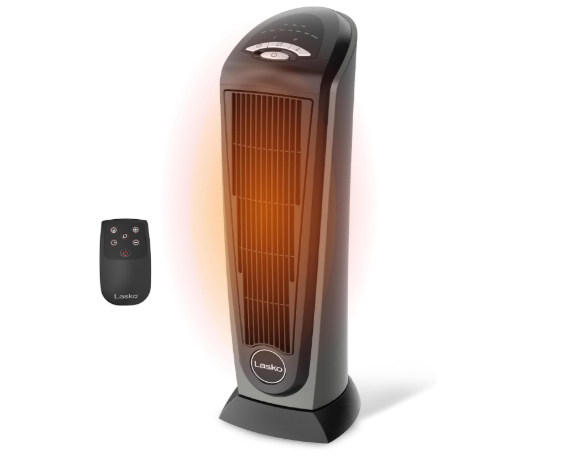
Lasko 751320 Ceramic Tower Heater
- 1500W ceramic heat
- Wide oscillation
- Remote and 7-hour timer
For Quiet Bedrooms
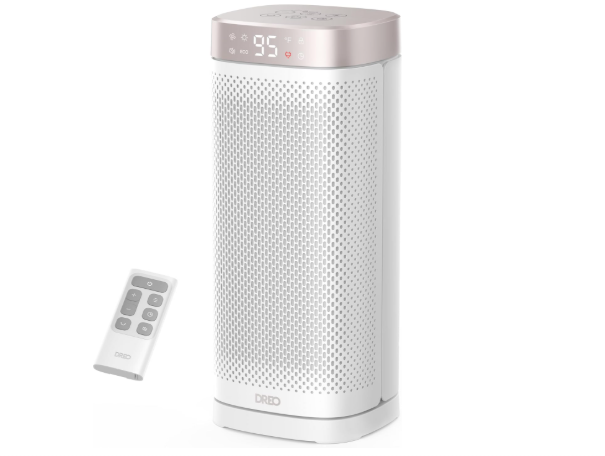
Dreo 16-Inch Oscillating Ceramic Heater
- Digital thermostat 41-95°F
- 70° oscillation
- Tip-over and overheat protection
What Ceramic Heaters Do Well and Where They Fall Short
Ceramic heaters shine at quick, targeted warmth. The ceramic element heats fast, and most models add a fan that pushes warm air into the room within moments of switching on.
Safety features are a real strength. Tip-over shutoff, overheat protection, and a listing from an independent testing lab are what separate a sound heater from a risky one.
Portability is another plus. Most units are light, have a handle, and need nothing more than a wall outlet, so one can follow you from a bedroom to a home office as the day changes.
The limits matter just as much. A ceramic heater is not more efficient than other electric heaters, because every plug-in electric heater turns the power it uses into heat. Most also have a fan, so they are quiet rather than silent, and they struggle in big, drafty rooms where 1500 watts can only do so much.
To choose the models below, we compared the safety protections, wattage, thermostat and timer controls, oscillation, size, and noise ratings each maker lists, then matched every heater to the room it suits.
1. Lasko 751320 Ceramic Tower Heater With Remote
The Lasko 751320 is a 23-inch tower that pairs 1500 watts of ceramic heat with widespread oscillation, so warmth reaches more of a medium room instead of one narrow spot. The self-regulating ceramic element and automatic overheat protection add safety, and the cool-touch housing makes the body safer to handle.
Control is simple. The remote handles heat level, oscillation, and the timer, and an adjustable thermostat lets the heater cycle instead of running flat out. A built-in carry handle makes moving it between rooms easy.
How It Fits Daily Use: Set the thermostat and timer from across the room, and let oscillation carry heat toward a bed or sofa. Its two heat levels give a quick warm-up on high and steadier upkeep once the room is comfortable.
Spec Highlights:
- 23-inch tower design
- Two heat settings plus adjustable thermostat
- Remote control and 7-hour auto-off timer
- Automatic overheat protection
Why It Stands Out:
- Oscillation spreads heat across a medium room
- Cool-touch housing for safer handling
- Built-in carry handle for room-to-room moves
Good Match For:
- Bedrooms and living rooms
- Home offices
- Evening use on a timer
Before You Buy: The tall, slim body takes little floor space, but give it the full three feet of clearance on all sides and plug it straight into a wall outlet.
2. Dreo 16-Inch Oscillating Ceramic Heater for Bedrooms
This 16-inch Dreo heater uses 1500-watt PTC ceramic heating with 70-degree oscillation to spread warmth across a bedroom or office. A digital thermostat sets the target anywhere from 41 to 95°F, so it holds a steady temperature rather than blasting heat.
Safety gets a lot of attention here. Dreo lists tip-over and overheat protection, a 24-hour auto-off, flame-retardant V-0 materials, and an ETL listing. A brushless DC motor keeps noise as low as 34 dB, and a child lock stops little hands from changing settings.
How It Fits Daily Use: Pick a target temperature on the digital thermostat and let it cycle, using the 12-hour timer to warm a bedroom before sleep. The child lock helps in homes where kids can reach the panel.
Spec Highlights:
- 1500W PTC ceramic heating element
- Digital thermostat from 41 to 95°F
- 12-hour timer and 24-hour auto-off
- Remote control and child lock
Why It Stands Out:
- Low-noise brushless DC motor
- Several layered safety protections
- Even warmth from 70-degree oscillation
Good Match For:
- Bedrooms and nurseries with supervision
- Home offices
- Shared rooms where noise matters
Before You Buy: Keep the remote handy, since many settings live on the digital panel and remote rather than physical dials.
3. Dreo Space Heater With Remote Control

This Dreo model pairs 1500-watt PTC ceramic heating with trackball-style 70-degree oscillation for wide, even warmth. Its ECO mode adjusts output to hold your set temperature, and the thermostat covers 41 to 95°F.
Going by the listed specifications, it runs as quietly as its newer 16-inch sibling, with a rating as low as 34 dB. Smart tip-over protection, overheat protection, V0 flame-retardant materials, and an ETL listing round out the safety side, and a remote and 12-hour timer handle daily control.
How It Fits Daily Use: ECO mode suits long workdays, since it trims output once the room holds its set temperature. The remote and timer keep adjustments simple from a desk chair.
Spec Highlights:
- 1500W PTC ceramic heating
- Trackball 70-degree oscillation
- ECO mode and adjustable thermostat
- Remote and 12-hour timer
Why It Stands Out:
- Quiet enough for focused work or sleep
- ECO mode helps limit run time
- Layered tip-over and overheat protection
Good Match For:
- Home offices
- Bedrooms
- Reading corners
Before You Buy: ECO mode lowers output once the room is warm, so it may feel slower than running on high in a very cold room.
4. Amazon Basics 500W Mini Ceramic Heater for Desks

This mini heater draws just 500 watts, which makes it a personal heater rather than a room heater. At roughly 6 inches tall and 1.4 pounds, it fits on a desk or under one and warms the person sitting nearby.
Tip-over protection shuts it off if it is knocked over, and the low wattage puts far less load on a shared office circuit than a 1500-watt unit. The listed 48 dB rating is noticeable but modest.
How It Fits Daily Use: Aim it at your legs or hands from a safe distance and switch it off when you step away. Its 500-watt draw leaves room on a circuit shared with a computer and monitor.
Spec Highlights:
- 500-watt ceramic element
- Built-in tip-over protection
- About 5.9 x 3.2 x 6 inches
- Lightweight 1.4-pound body
Why It Stands Out:
- Low power draw for shared circuits
- Takes almost no desk space
- Easy to carry between rooms
Good Match For:
- Office desks and cubicles
- Under-desk foot warming
- Small craft or hobby corners
Before You Buy: Keep papers and fabric well away from the grille, since a desk setup puts it close to flammable items.
5. Amazon Basics Oscillating Ceramic Heater With Thermostat

This compact heater offers three settings: high at 1500 watts, low at 900 watts, and a fan-only mode for air circulation. A 45-degree oscillation spreads warmth across a small room, and an adjustable thermostat helps it cycle once the room warms up.
At about 7.5 by 6.3 by 9.5 inches and 3 pounds, it is easy to move from room to room. Tip-over protection, overheat protection, and a power indicator light cover the basics.
How It Fits Daily Use: Start on high to take the chill off, then drop to the 900-watt low setting and let the thermostat hold the room. Fan-only mode keeps it useful for air circulation in warmer months.
Spec Highlights:
- High 1500W, low 900W, and fan-only modes
- 45-degree oscillation
- Tip-over and overheat protection
- Power indicator light
Why It Stands Out:
- Compact and light at about 3 pounds
- Low setting eases circuit load
- Fan mode for warmer months
Good Match For:
- Small bedrooms
- Home offices
- Dorm-style rooms where allowed
Before You Buy: The thermostat dial is unmarked, so expect a little trial and error to find a comfortable setting.
Matching Ceramic Heater Wattage to Room Size and Insulation
A common rule of thumb is about 10 watts of heating power per square foot. By that guide, a 1500-watt heater suits a room around 150 square feet, such as a small bedroom or home office, while a 500-watt unit warms one person at a desk.
The rule assumes standard ceilings and decent insulation. Older homes, high ceilings, large windows, and drafts all lower what a heater can achieve, so treat the number as a starting point rather than a promise.
Because 1500 watts is the usual ceiling for a plug-in heater, a bigger space may need a different approach. Our guide to space heaters for large rooms covers options for open layouts.
Insulation does the quiet work. Closing the door, hanging thick curtains, and sealing gaps near windows keep warm air in, so the heater cycles off sooner and the room feels steadier.
Running Costs and Simple Ways to Lower Them
A ceramic heater’s running cost depends on its wattage and how long it runs, not on the heater type. Plug-in electric resistance heaters turn nearly all their power into heat, so a ceramic model has no efficiency edge over a basic fan or oil-filled unit.
You can estimate the cost yourself. Divide the wattage by 1,000 to get kilowatts, multiply by hours of use, then multiply by your utility rate per kilowatt-hour. A 1500-watt heater running for 10 hours uses 15 kilowatt-hours.
The thermostat is your best savings tool. Once the room reaches the set temperature, the heater cycles off, so it draws power only part of the time. A timer helps too, especially for warming a bedroom before bed.
Heat only the room you are using, and lower your central thermostat while you do. Without that step, the heater’s cost simply adds to your normal heating bill.
Ceramic Versus Oil Fan and Infrared Heater Types
Each electric heater type has a different feel, even though they all use power the same way. For a deeper look at one pairing, see our ceramic and oil-filled heater comparison.
- Ceramic. Warms air over a ceramic element, often with a fan. It heats fast and is light, though fan noise and drier-feeling air are possible.
- Oil-filled. Takes longer to warm up but keeps radiating heat after the thermostat shuts off. It runs quietly and is heavier to move.
- Fan heater. Uses a metal coil instead of ceramic plates, with a similar fan-driven feel.
- Infrared. Heats people and objects directly rather than the air, which suits one seated spot more than a whole room.
At the same wattage, all of them cost about the same to run, so choose by warm-up speed, noise, and room coverage.
Smart Placement and Daily Habits Around the Heater
Where and how you use a heater matters as much as which one you buy. The U.S. Consumer Product Safety Commission urges caution with space heaters every winter and stresses clearance and supervision, and our ceramic heater safety guide covers the risks in more detail.
- Choose a flat, hard floor. Never set a heater on furniture or a soft rug where it can tip.
- Keep three feet clear. Curtains, bedding, furniture, and paper should stay at least three feet away.
- Plug straight into the wall. Skip extension cords and power strips.
- Turn it off when you leave or sleep. Use a timer to pre-warm a room instead of running it all night.
- Stay dry. Keep the heater away from water, and never touch it with wet hands.
Standard ceramic heaters are made for indoor use only, so keep them off damp patios and out of garages with fuel or solvent fumes.
Outlet and Circuit Limits for a 1500 Watt Heater
Most plug-in ceramic heaters run at 1500 watts on high. At standard 120 volts, that draws about 12.5 amps, which is most of what a common 15-amp household circuit can carry.
Everything else on the same circuit adds to that load. A vacuum, hair dryer, or second heater can trip the breaker, so keep other high-wattage devices off that circuit while the heater runs. The low setting on many models eases the load when the room is already warm.
Know the warning signs. A breaker that trips again and again, or a plug or outlet that feels warm or looks discolored, means it is time to unplug and have an electrician look. The Massachusetts space heater safety guide also advises plugging heaters directly into a wall outlet for this reason.
Why a Ceramic Heater Keeps Shutting Off by Itself
A heater that clicks off is not always broken. Often a built-in feature is doing its job.
Start with the thermostat. Once the room reaches your set temperature, the heater pauses and restarts as the air cools. A timer or auto-off setting can also end a session you forgot you set.
Next, check the tip-over switch. A soft rug, a tilted surface, or an object leaning on the heater can make it think it has fallen. Move it to a flat, hard floor and restart it.
Overheat protection is the more serious cause. A heater pushed against a wall or furniture, or one with blocked airflow, can shut down to protect itself, so giving it open space is the first fix to try. If it still shuts off after these checks, unplug it and contact the maker or replace the unit.
Indoor Air, Odors, and Routine Cleaning Care
Ceramic heaters burn no fuel, so they add no combustion fumes to your room. They do not remove moisture either, but warming a room lowers its relative humidity, so the air can feel drier. A small humidifier placed away from the heater can offset that.
Fan-driven models can stir up settled dust, and dust that lands on a hot element can give off a brief burning smell. New units often give off a faint odor in their first hours. If a smell is strong, lasts, or smells like burning plastic, switch off and unplug the heater.
Routine care is simple. Unplug the heater and let it cool, then wipe the body with a dry cloth and use a vacuum brush on the vents. Skip water and sprays, check the cord for fraying or cracks, and store the heater in a dry spot in the off-season.
Quick Answers to Common Ceramic Heater Questions
Can I leave a ceramic heater on overnight?
Fire safety groups advise turning space heaters off and unplugging them when you go to bed or leave the room. A heater is not a substitute for warm bedding or your main heating system overnight. If you want a warm bedroom, set the timer to heat the room for an hour or two before sleep, then let it shut off. Built-in protections lower the risk, but they do not make unattended overnight use a safe habit.
Is a ceramic heater safe around kids and pets?
Safety features lower the risk but do not remove it. Tip-over and overheat protection help, yet the front grille can still get hot enough to hurt skin or fur. Many models have a cool-touch body, so check the manual for which parts stay cool. Keep children and pets out of the three-foot zone around the heater, choose a model with a child lock if small hands can reach the controls, and never leave kids alone with it running.
Are ceramic heaters safe to use in a bathroom?
Only if the manual says the model is made for bathroom use. Most ceramic heaters are not rated for damp rooms, and water near electrical parts raises the risk of shock and fire. Even a bathroom-rated heater needs to stay well away from tubs, sinks, and showers, and you should never touch it with wet hands. If the manual does not mention bathrooms, keep the heater in a dry room and find another way to warm the space.
How long does a ceramic heater last?
There is no fixed lifespan. It depends on build quality, how many hours the heater runs each winter, and how much dust it collects. Owner reports vary widely, with some noticing weaker heat after a few seasons and others getting many years of use. Check the warranty length before you buy and keep the receipt. Replace any heater that heats poorly, has a damaged cord, or shows signs of heat damage around the plug or grille.
Should you replace an older ceramic heater?
Older heaters may lack newer safety features, and parts wear with age. Portable electric heaters made after 1991 must meet more safety requirements than earlier ones. If your heater is old, has a frayed cord, a missing guard, or no tip-over or overheat protection, replace it with a model listed by an independent testing lab such as UL or ETL. A heater that still turns on is not automatically a heater that is still safe to use.
Final Advice for Choosing the Best Ceramic Heater
A ceramic heater is a handy way to add warmth to one room, as long as you match its wattage to the space and use it with care. Look for a safety listing, a thermostat, and tip-over and overheat protection first, then decide on extras like oscillation, a remote, or a timer based on how you will use it.
For a desk or single seat, a low-wattage personal unit is enough. For a bedroom or office, a 1500-watt model with a thermostat does the job. Keep it on a hard floor, plug it into the wall, and switch it off when you leave the room.
