
6 Best Double Burner Hot Plates Reviewed for 2026

Disclosure: As an Amazon Associate, I earn from qualifying purchases. Learn more
For most small kitchens, an 1800-watt double burner with separate controls covers daily cooking, with an infrared glass top for easier cleanup or cast iron plates for simple durability. Two burners turn a quiet corner into a working kitchen.
The tricky part is that every listing promises fast, even heat, while the details that matter hide in the specs: how watts split between burners, which pans each top accepts, and whether your outlet can carry the load.
Before you pick, weigh three things: power per burner, cookware compatibility, and safety features like thermostats and auto shutoff. Below you will find six double burner models, how each one splits its power, and the setup and care habits that keep a countertop cooktop working safely for years.
The Vayepro Infrared Double Burner pairs 900-watt burners with a glass top for mixed cookware, while the OVENTE Infrared Double Burner offers a sleek crystallite surface for lighter cooking.
For Mixed Cookware Kitchens

Vayepro Infrared Double Burner
- 900W per burner
- Works with glass and aluminum
- Thermal fuse protection
For Easy Wipe Cleanup

OVENTE Infrared Double Burner
- 750W per plate
- Crystallite ceramic glass
- Stainless steel housing
Why a Double Burner Hot Plate Earns Its Counter Space
A double burner hot plate adds two cooking zones anywhere you have a counter and an outlet. That helps in dorms, studios, offices, and RVs, and it gives a full kitchen extra room during holiday cooking.
With independent controls, you can boil pasta on one side and warm sauce on the other, which turns a one-pan setup into real meal prep.
Most models are compact and light enough to store in a cabinet between uses, so you gain extra capacity without a permanent appliance.
Keep expectations realistic, though. A plug-in unit shares one household circuit, so it works best as a supplement or a stopgap rather than a full range replacement.
1. Vayepro Infrared Double Burner for Mixed Cookware Kitchens
If your cookware drawer holds aluminum, stainless, glass, and ceramic pans, this infrared cooktop works with all of them as long as the bottoms are flat. Each burner runs at 900 watts, and the elements cycle on and off to hold your chosen setting.
A stainless steel body with a smooth ceramic glass surface keeps cleanup quick, and the compact shape fits dorm desks, office break rooms, and RV counters.
Real-Use Fit: An even split between burners makes it easy to simmer on one side while warming a second dish on the other.
Feature Spotlight:
- Works with non-magnetic cookware, unlike induction
- Automatic cycling to maintain heat
Why It Helps:
- Uses pans you already own
- Wipes clean easily once cool
- Packs into a cabinet when not needed
Fits Best With:
- Flat-bottom aluminum and stainless pans
- Glass and ceramic cookware
- Dorms, offices, and RV counters
Good To Know: The element cycling off is normal, not a fault, and covering pots helps water boil faster on 900-watt burners.
2. OVENTE Infrared Double Burner With a Crystallite Glass Top
Infrared heating sits under a ceramic glass surface, with 750 watts per plate for 1500 watts total. Turn the adjustable control knob to set the temperature, and the light shows when the burner is working.
The listing says it works with virtually all cookware types, and the stainless steel housing paired with a smooth top makes splatter cleanup fast.
Real-Use Fit: Lower wattage per plate suits eggs, sauces, and reheating better than big-batch boiling.
Feature Spotlight:
- 7.5-inch ceramic glass cooktop per the listing
- Stainless steel housing
Why It Helps:
- No special cookware needed
- Smooth top for quick wipe-downs
- Light enough to store away
Fits Best With:
- Most flat-bottom pots and pans
- Small apartments and dorms
- Extra holiday cooking space
Good To Know: At 750 watts per plate, heating is gentler than 900-watt models, so plan extra time for pasta water or soup.
3. Elite Gourmet EDB-302BF Double Burner With Cast Iron Plates

Picture a dorm room or office kitchenette where you need eggs on one side and soup on the other. This unit gives you a 6.5-inch and a 5-inch cast iron plate, each with its own variable temperature control for low, medium, or high heat.
The flat plates are nonstick and easy to clean with a damp cloth, and the compact body travels easily to wherever you need an extra burner.
Real-Use Fit: Two plate sizes make it easy to match a small saucepan and a mid-size skillet side by side.
Feature Spotlight:
- Individual controls for each plate
- Power lights show when it is on
Why It Helps:
- Straightforward knobs with no learning curve
- Flat plates wipe clean
- Small enough to stash in a cabinet
Fits Best With:
- Saucepans and skillets near plate size
- Dorms, offices, and powered campsites
- Flat-bottom cookware
Good To Know: The 5-inch plate is small, so wide pans will overhang it, and cast iron plates stay hot well after you switch off.
4. CUSIMAX Cast Iron Double Hot Plate With Equal Burners

The main benefit is steady, simple power: 900 watts per plate, 1800 watts total, from burners that switch on with a single knob. A built-in thermostat cycles power to hold your setting, and the listing describes an automatic safety shutoff with temperature regulation.
It suits pots and pans up to 7.4 and 6.1 inches and works with glass and aluminum cookware.
Real-Use Fit: Matching 900-watt plates let both burners carry real cooking loads at the same time.
Feature Spotlight:
- Thermostat that cycles to maintain heat
- Stainless steel silver body
Why It Helps:
- Equal power on both sides
- Works with glass and aluminum pans
- Simple one-knob operation
Fits Best With:
- Pans up to 7.4 and 6.1 inches
- Glass and aluminum cookware
- Heat-resistant countertops
Good To Know: The maker advises a heat-resistant surface and reading the manual before first use, and the plates stay hot after cooking.
5. Techwood Double Burner Hot Plate for RVs and Studios

Two thermostatically controlled burners deliver 1800 watts in a compact, flat design made for dorms, studios, and RV kitchens. The listing says it works with any cookware type, including aluminum, copper, cast iron, and non-magnetic stainless steel pans.
A brushed stainless steel housing gives it a clean look on any counter, and the light build makes it easy to carry between rooms.
Real-Use Fit: The flat profile stores easily between meals in small spaces.
Feature Spotlight:
- Riveted stainless handle stays cool
- Works with copper and non-magnetic pans
Why It Helps:
- Uses nearly any pan you own
- Stays steady on the counter
- Easy to carry between rooms
Fits Best With:
- Aluminum, copper, and cast iron pans
- RVs, studios, and dorm rooms
- Everyday side-dish cooking
Good To Know: The listing gives few details on the heat range of each burner, so test settings with water before cooking delicate sauces.
6. Cuisinart CB-60 Double Burner With a Strong Main Burner
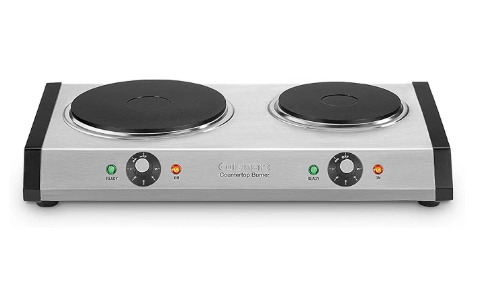
If you often sear or boil on one side while holding a sauce warm on the other, the uneven split works in your favor: a 1300-watt primary burner and a 500-watt secondary burner.
Each has its own 6-setting adjustable thermostat, and heavy-duty cast iron plates are built for durability over years of extra-burner duty.
Real-Use Fit: The strong main burner handles pasta water while the smaller one keeps sides warm without scorching.
Feature Spotlight:
- Ready light shows when a plate reaches temperature
- Independent thermostats for each burner
Why It Helps:
- Power where you need it most
- Gentle low heat for warming
- Stable stance while stirring
Fits Best With:
- Heavy pots on the main burner
- Small saucepans on the secondary plate
- Holiday and buffet overflow cooking
Good To Know: The 500-watt burner is mainly for warming and gentle simmering, so do not expect it to boil large pots quickly.
What to Check Before Buying a Two Burner Hot Plate
These points separate a hot plate you keep using from one that ends up in a closet.
Power per burner: total wattage matters less than how it splits. Equal 900-watt burners handle two real dishes, while a 1300 and 500-watt split favors one main burner and one warmer.
Burner type: infrared glass, cast iron, coil, and induction tops heat and clean differently, as the next section explains.
Cookware fit: check the listed maximum pan size and whether your pans need flat bottoms.
Controls: separate knobs for each burner, clear heat steps, and indicator lights make daily use easier.
Safety features: look for a thermostat, overheat protection such as a thermal fuse or auto shutoff, and non-slip feet.
Cleaning: smooth glass wipes clean fastest, while cast iron and coil designs need more care around the edges.
If you are still comparing formats, these countertop burner choices include single-burner designs too.
Infrared, Cast Iron, Coil, or Induction Burners Compared
The burner type decides how fast a hot plate heats, which pans it accepts, and how much effort cleanup takes.
Infrared Glass Tops
Infrared elements heat under a smooth glass surface and work with most flat-bottom cookware, including aluminum and glass. They wipe clean easily, but the glass stays hot for a while after use.
Cast Iron Plates
Solid cast iron plates heat evenly and hold warmth, which helps with simmering. They take longer to heat and cool, and they last longer when you keep them dry.
Coil Burners
Exposed coils heat quickly and suit basic boiling and frying. Spills can drip around the coil, so cleanup takes more effort. These coil cooktop options show how coil designs vary.
Induction Burners
Induction heats the pan directly through magnetism, so the surface around it stays cooler. University extension guidance notes that induction cookware must contain ferrous iron and have a flat bottom, and a magnet that sticks to the base is a quick test. If you own coated pans, check ceramic pans on induction before switching.
Double Burner or Single Burner for Your Space
A double burner lets you cook two dishes at once, which saves time for full meals or when you cook for two or more people.
A single burner is smaller and lighter, so it suits solo cooks, travel, or a desk with little room. It also leaves more of your circuit free for other appliances.
Think about your typical meal. Pasta and sauce, eggs and bacon, or rice and a stir-fry all go faster with two zones.
If you mostly reheat or make one-pan dishes, a single unit may be enough, and these more hot plate options include single-burner picks worth comparing.
Wattage, Outlets, and Circuit Load Explained
Most double burners here draw up to 1800 watts, which works out to about 15 amps at 120 volts. That fills a standard 15-amp household circuit, so running a microwave or kettle on the same circuit can trip the breaker.
Going by the listed specifications, the Cuisinart splits its 1800 watts into a 1300-watt and a 500-watt burner, while the CUSIMAX runs two 900-watt plates and the OVENTE infrared model tops out at 1500 watts.
Plug directly into a wall outlet rather than a power strip or extension cord, which can overheat under a high load.
If your breaker trips often, move to an outlet on a different circuit or run one burner at a time.
Safe Setup and Use of a Portable Hot Plate
Federal fire safety data shows cooking is by far the leading cause of home fires, and unattended equipment is the top ignition factor in many cooking fires. These steps keep a portable burner safe.
1. Choose a stable, heat-resistant surface. Keep it level and away from curtains, paper towels, and the counter edge.
2. Check the cord and plug. Skip use if either is frayed, cracked, or warm to the touch.
3. Use flat-bottom cookware sized to the burner. Overhanging pans heat unevenly and tip more easily.
4. Stay nearby while cooking. Turn the unit off if you step away, even briefly.
5. Let it cool before moving or storing. Glass and cast iron surfaces stay hot well after you switch off.
6. Unplug after each use. A switched-off unit left plugged in can still be bumped on.
Cooking Two Dishes at Once Without the Chaos
Two burners shine when you plan the order. Start the dish that takes longest, such as pasta water or rice, on the stronger burner.
Use the second burner for sauces, sautéed vegetables, or eggs, and turn it to low once the food is ready so it stays warm.
Try simple pairings: spaghetti with garlic and oil, rice with a quick stir-fry, or soup with grilled cheese.
Keep lids handy. Covering pots helps them heat faster on modest burners and keeps splatter off the glass or plates.
Cleaning and Care for Glass and Cast Iron Burners
Always unplug the unit and let it cool before cleaning. Wipe glass tops with a damp cloth and mild soap, and lift stubborn spots with a paste of baking soda and water.
Skip abrasive scrubbers on glass, since they can leave scratches. For cast iron plates, wipe with a barely damp cloth and dry them fully.
Clean around knobs and vents with a dry cloth so grease does not build up, and never immerse the unit in water.
Check the cord and plug every few weeks, and stop using the unit if you see damage or smell burning plastic.
Common Mistakes With Double Burner Hot Plates
A few habits cause most hot plate problems.
- Sharing a crowded circuit. An 1800-watt unit plus a microwave can trip the breaker and stress the wiring.
- Using an extension cord or power strip. Thin cords can overheat under a high, steady load.
- Choosing oversized pans. Pans much wider than the burner heat unevenly and can tip.
- Leaving it plugged in and unattended. Unattended cooking is a leading factor in kitchen fires.
- Buying induction without magnetic pans. An induction burner will not heat aluminum, glass, or copper cookware.
- Cleaning while hot. Wiping a hot glass top or cast iron plate risks burns and streaks.
Questions People Ask About Two Burner Hot Plates
How Much Electricity Does a Double Burner Hot Plate Use?
An 1800-watt unit running both burners on high uses about 1.8 kilowatt hours each hour. In real cooking the thermostat cycles the elements on and off, and you rarely run both sides on high for long, so actual use is usually lower. Your cost depends on your local electric rate and cooking time. Using lids, matching pan size to the burner, and turning off a burner a minute early to coast on stored heat all trim energy use.
Can a Double Burner Hot Plate Replace a Full Stove?
For a dorm, studio, office, or RV, a double burner can handle most stovetop meals, from pasta to stir-fries. It has no oven, though, and plug-in burners usually heat more slowly than a full-size range because they share one household circuit. Many people use one as a temporary stove during a kitchen remodel or as extra capacity during holidays. If you cook large batches every day, treat it as a supplement rather than a permanent replacement.
Is It Safe to Use a Hot Plate on a Wooden or Laminate Counter?
Check the manual first, since several makers recommend a heat-resistant surface. The bottom of a hot plate can get warm, and heat may discolor some laminate or finished wood over time. Keep the unit on its feet so air can circulate underneath, never block vents, and leave space around the sides. Stone, tile, or a heat-safe board under the unit adds a margin of safety, as long as it stays flat and stable.
Why Does My Hot Plate Keep Turning Off and On?
On most models this is normal. A thermostat switches the element on and off to hold the heat level you set, and some listings, such as the Vayepro, describe this cycling as expected behavior. If the unit shuts off completely and will not restart until it cools, an overheat protector such as a thermal fuse or auto shutoff may have tripped. Let it cool, check that vents are clear, and stop using it if the problem repeats.
Do Hot Plates Work With Cast Iron Skillets?
Yes. Cast iron works on infrared glass, cast iron plates, coil burners, and induction tops, since it is magnetic and has a flat base. On glass surfaces, lift the skillet rather than sliding it to avoid scratches, and set it down gently because it is heavy. Preheat cast iron gradually on a medium setting, since a cold skillet on high heat can warm unevenly on a small burner.
Picking the Right Double Burner for Your Kitchen
For mixed cookware and easy cleanup, the Vayepro or OVENTE infrared models fit best, while the CUSIMAX gives you two equal cast iron burners and the Elite Gourmet keeps controls simple. The Cuisinart CB-60 suits cooks who want one strong burner and one warmer, and the Techwood works well in RVs and studios. All of them share one household circuit and heat more gently than a full range. A simple rule helps: choose the burner type that matches your pans, then the power split that matches how you cook two dishes at once.
