Common Glass Top Stove Problems! Causes and Fixes

Most glass top stove problems come from four things: scratches from rough or sliding cookware, burnt-on spills, a failed heating element or switch, and cracks from impact or heat stress. Many of them are easy to prevent, and a few are not safe to fix yourself.
Maybe you noticed a faint scratch after sliding a pan, a cloudy patch that will not wipe off, or a burner that heats for a minute and then shuts off. It is easy to wonder whether the stove is ruined. In most cases it is not, but a cracked surface and a burner that will not shut off need immediate caution.
This guide explains what each problem usually means, what you can safely try, and when we would stop and call a technician. We also cover sugar spills and melted plastic, which cause damage many people only notice after the surface has cooled.
Scratches on Glass Stove Tops and How to Stop Them
Scratches are the most common complaint, and they rarely come from one big event. They build up from small habits repeated over months.
The glass-ceramic surface is tempered, so it handles heat well but scratches more easily than most people expect. Grit trapped between a pan and the glass works like sandpaper.
Sliding pans across the surface
Lift pans on and off instead of dragging them. A pan that rocks back and forth while you stir can also grind tiny particles into the glass.
Rough or heavy cookware
Bare cast iron and pans with rough, unfinished bottoms can scratch glass. If you cook with cast iron on a smooth top, read about cast iron on glass first and always lift the pan.
Copper and some aluminum bottoms can also leave metal marks or residue on the surface.
Crumbs, salt, and grit
Salt, sugar, and grains of sand scratch the glass when a pan moves over them. Wipe both the cooktop and the pan bottom before you cook.
Harsh cleaning tools
Steel wool and scouring pads scratch glass. A cooktop cleaner and a non-abrasive pad are the safer choice.
Dried cleaner residue can leave a hazy film, so wipe it off with a damp cloth and buff the surface dry.
Falling objects
Heavy items stored in the cabinet above the stove can fall and chip or crack the glass. Keep glass jars and ceramic dishes somewhere else.
Light scratches often become less visible after a cooktop cleaning cream, but deep scratches cannot be buffed out. If you are unsure what you are looking at, see these other kinds of surface damage.
What Causes Black Glass Top Stove Discoloration and Stains?

Discoloration usually means something is sitting on the glass, not that the glass itself has changed. Most of it lifts with the right cleaner and a little patience.
Burnt-on food and grease
Residue that is not cleaned off bakes on each time you cook. It also creates hot spots that stress the glass, so clean the surface once it is safe to touch.
Metal marks from pan bottoms
A thin aluminum smear or copper residue can look like a gray or dark stain. Switching to flat stainless or clad cookware leaves less behind.
Mineral haze from water
Cloudy white patches often come from hard water minerals left after a boil-over or a wet pan. A cooktop cleaner removes most of it.
Wear that will not clean off
Years of use, heavy scratching, and pitting can leave a dull look that cleaning cannot reverse. That is cosmetic wear rather than a failing stove. If the finish looks like it is flaking, read about surface peeling and its causes.
For a basic routine, let the cooktop cool, use a cleaner made for glass-ceramic surfaces and a non-abrasive pad, then wipe with a damp cloth and buff dry. A white vinegar spray followed by baking soda under a damp towel is a gentler home option for light grease. For a full routine, see cleaning a ceramic glass cooktop.
Sugar and Melted Plastic Can Pit Your Glass Stove Top
Sugar and plastic behave differently from other spills. If they bond to a hot surface and cool there, they can pit the glass.
Jam, syrup, candy, a melted bag, a plastic utensil, or aluminum foil are the usual causes. Act while the spill is still hot, but protect your hands.
- Step 1: Turn off the burner and use oven mitts to move the hot pan away.
- Step 2: Wearing oven mitts, hold a single-edge razor scraper made for cooktops at a low angle and push the spill toward a cool area.
- Step 3: Wipe up the loosened spill with paper towels and leave the rest until the glass cools.
- Step 4: Once cool, clean with cooktop cleaner and buff dry.
Pitting that has already formed will not clean away. Manufacturer guidance generally says deep pitting means the glass has to be replaced.
If Your Electric Glass Top Stove Burner Is Not Working
How to fix a burner on a glass top stove depends on which part failed. On an electric model, a burner that stays cold is usually a setting problem, a power problem, or a failed part under the glass.
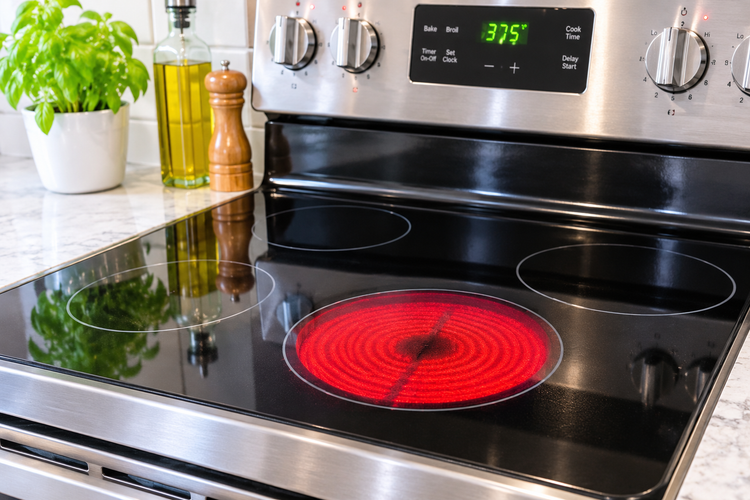
Start with the checks that cost nothing:
- Control lock: many cooktops have a lock that disables every burner. Look for a key icon on the panel and turn the lock off as your manual describes.
- Burner zone: dual-zone burners have inner and outer zones that switch on separately, so check you selected the right one.
- Breaker: a tripped breaker can cut power to the whole range. Reset it once, and call an electrician if it trips again.
If one burner (some people call it the eye) is dead while the others work, the cause is usually the heating element or the infinite switch, the control that sends power to that burner.
Both sit under the glass and involve high voltage. Switch off the range at the breaker and let a qualified technician test them. Replacing a failed burner element on a glass cooktop is not a job to attempt with the power on.
If several burners fail at once, a control board or the power supply is more likely.
A glass top gas model is different. Burners that click but do not light usually need a clean igniter and clear ports. If you ever smell gas, leave the home and call your gas utility.
Why a Glass Top Stove Burner Turns On and Off
Some on and off behavior is normal. Electric elements cycle to hold a temperature, especially at low and medium settings.
Many cooktops also use sensors that cycle or shut off a burner to protect the glass from extreme heat.
It becomes a problem when the burner heats briefly and then stops, or cycles much faster than it used to. These are the usual causes:
- Wrong pan size: a pan that overhangs the zone a lot or sits unevenly can trip the protection. Match the pan to the burner.
- Dirty surface or pan bottom: residue creates hot spots that the sensor reacts to.
- Empty or boiled-dry pan: heat builds fast and the burner shuts down to protect the glass.
- Poor airflow under the unit: an installation problem a technician should check.
- Loose wiring or a failing control: another job for a technician.
A brief power interruption stops every burner at once. It does not point to a faulty single burner.
If the burner keeps cutting out with a clean, flat, matching pan, have a technician check the element, the limiter, and the wiring.
Glass Top Stove Burner Stuck on High or Too Hot
Two different problems hide here. Either the burner runs hotter than the dial setting, or it will not shut off.
Burner runs hotter than the setting
- Warped or rough pan: uneven contact creates hot spots.
- Pan that is too small: undersized cookware leaves part of the element exposed, which can also ignite loose clothing.
- Food residue under the pan: it burns on and holds heat.
- Setting too high: use medium for most cooking and keep high for boiling.
- Range not level: a tilted range makes oil and liquids collect on one side of the pan.
Burner stays on at full power
A switch that no longer regulates, usually the infinite switch, can leave a burner running at full power wherever the knob sits.
Turn the knob off, and if the element keeps glowing, cut power at the breaker and call a technician. Official fire safety guidance from state fire officials advises staying in the kitchen while boiling, broiling, or frying, and never moving a burning pan or dousing it with water.
Can You Safely Use a Cracked Glass Top Stove?
No. Even a hairline crack means the surface should not be used, and we would turn the burners off right away.
Even small cracks raise the risk of electric shock, because spilled liquid can reach live parts under the glass. Heat stress can also break glass, so a cracked surface is not a safe place to keep cooking.
What to do right away
- Turn off every burner and let the surface cool.
- Switch off the range at the breaker.
- Keep pans, liquids, and cleaning sprays off the damaged glass.
- Call a technician or the manufacturer service line and have your model number ready.
Why glass tops crack
Impact from heavy pans or falling items is one cause. Scratches that weaken the glass over time and heat stress are others.
University extension guidance notes that tempered glass cooktops scratch more easily and can crack when items are dropped on them. It also notes that long heat exposure and food residue hot spots can stress the surface.
Everyday Habits That Prevent Most Glass Top Stove Problems
- Lift pans instead of sliding them.
- Choose flat, smooth-bottom cookware sized to the burner.
- Wipe the cooktop and the pan bottoms before you cook.
- Clean spills once the surface is safe to touch, and clean sugary ones as soon as you safely can.
- Use a cleaner made for glass-ceramic surfaces, never steel wool.
- Keep heavy or breakable items out of the cabinet directly above.
- Do not set wet pans on the cooktop or pour cold water on a hot surface.
- Do not use the cooktop as a cutting board or extra counter.
- Check your manual for weight limits and cookware advice.
When to Call a Technician for Glass Top Range Problems
Cleaning, changing cookware habits, and checking the lock, zone, and breaker are safe first steps. Anything that involves lifting the glass or touching wiring is different, because it involves high voltage.
Call a professional if any of these apply:
- The glass is cracked or chipped.
- A burner will not turn off.
- Several burners fail together.
- The breaker keeps tripping.
- You smell burning on a clean cooktop, or see smoke or sparks.
- The glass is deeply pitted.
Quick reference for the first move:
- Light scratches: switch to flat, smooth cookware.
- Cloudy haze: clean with cooktop cream and buff dry.
- Sugar or plastic spill: turn the burner off and scrape it while it is hot, wearing mitts.
- Burner will not heat: check the lock, zone, and breaker.
- Burner will not turn off: cut power at the breaker and call a pro.
- Any crack: stop using the stove and turn off the power.
Frequently Asked Questions
Can the glass top of a stove be replaced?
Sometimes, and it depends on the model. Many ranges let a technician replace the glass-ceramic surface, while a large crack or damage to the parts underneath can mean replacing the whole cooktop. Gluing or sealing a crack, including the epoxy methods used on car windshields, does not work on tempered glass. Look up your model number, ask the manufacturer or a technician for a quote on the glass panel, and compare it with the cost of a new cooktop before you decide.
How can I tell if a pan is flat enough for a glass top stove?
Turn the pan upside down on the counter and rest the straight edge of a ruler across the bottom. Rotate the ruler in a full circle. You should see no gap or light between the ruler and the pan. Also check the size: the pan should cover the burner without hanging more than about half an inch past its edge. Rounded, warped, ribbed, or dented bottoms heat unevenly and can leave the glass under extra stress.
Why is my glass top stove slow to heat or not hot enough?
Glass conducts heat poorly, so an electric glass top responds more slowly than gas flames and also cools slowly after you lower the setting. Use a flat pan that matches the burner so heat transfers well. For rice, pasta, or eggs that need a hard boil followed by a gentle simmer, bring the pot to a boil on one burner and move it to a second burner already set low. If heat stays weak with a good pan, have the element checked.
Why does my glass top stove smell like burning?
The usual cause is residue: a small spill, grease, a sugary drip, or melted plastic or foil heating up on the surface. Turn the burner off, let it cool, and clean the area. If the smell returns on a clean cooktop, or you notice smoke, sparks, or a hot plastic odor coming from the controls or the range itself, switch off the power at the breaker and call a technician instead of using it again.
Why does the hot surface light stay on after I turn the burner off?
The indicator is a warning, not a fault. The glass keeps radiating heat after the controls are off, and the light stays lit until the surface has cooled to a safer temperature. Avoid wiping, resting hands, or setting plastic items on the glass while the light is on. If the light never goes out even after the cooktop is clearly cool, or a burner still glows with the knob off, treat it as an electrical problem and have it checked.
Bringing It All Together
Most glass top stove trouble traces back to a few causes: grit and rough cookware, residue left to bake on, sugar or plastic that cooled on the glass, and electrical parts that wear out under the surface.
The fixes follow the same pattern. Better cookware habits and gentle cleaning handle the surface problems, while burner and switch faults belong to a technician.
A little care after each use keeps most of these problems from starting, and a cracked surface or a burner that will not shut off should always be treated as a stop-and-call situation.
