
LF Bros Diesel Heater Review With Safety and Runtime Tips

Disclosure: As an Amazon Associate, I earn from qualifying purchases. Learn more
This LF Bros diesel heater review looks at how the heater behaves in garages, RVs, and workshops, and what you should know before running it for hours at a time. Many heating complaints trace back to setup, airflow, and fuel habits, so those get the most attention here.
If you are weighing a diesel heater, you probably want to know whether the advertised output is realistic, how loud it gets, and whether accessories are really needed. You will also see where to place a carbon monoxide alarm, how to estimate runtime from tank size, and which habits keep the burner running cleanly.
Quick Heater Picks
Consider the LF Bros Plateau Mode Diesel Heater if you plan longer sessions, since it pairs a 24-hour timer with plateau mode for high-altitude use and built-in protections. → View on Amazon
A smart choice for flexible power setups is the LF Bros Stylish Diesel Heater, which lists 12V, 24V, and 110V input along with six built-in protections and a remote. → View on Amazon
No diesel heater is safe without exhaust routed fully outdoors and proper ventilation, so treat the setup steps below as the foundation for everything else.
How the LF Bros Diesel Heater Works in Real Conditions
LF Bros diesel heaters are forced-air diesel air heaters that burn fuel inside a sealed chamber while pushing warm air into the room using a fan. Electrical power only runs the controller, fan, and fuel pump, which keeps energy consumption low compared to electric heaters.
In real-world use, heat delivery is fast and noticeable within minutes. Performance depends heavily on exhaust flow, clean air intake, and stable fuel delivery. Even small restrictions in the exhaust pipe or ducting can reduce output and cause odor issues. The all-in-one design simplifies placement, but ventilation remains essential.
Noise mainly comes from the fuel pump pulse and the airflow fan. In garages and workshops, this is usually acceptable. In RVs or camping setups, distance and sound insulation matter more. When treated as a mechanical heating system rather than a plug-in appliance, performance is generally consistent.
Top Pick
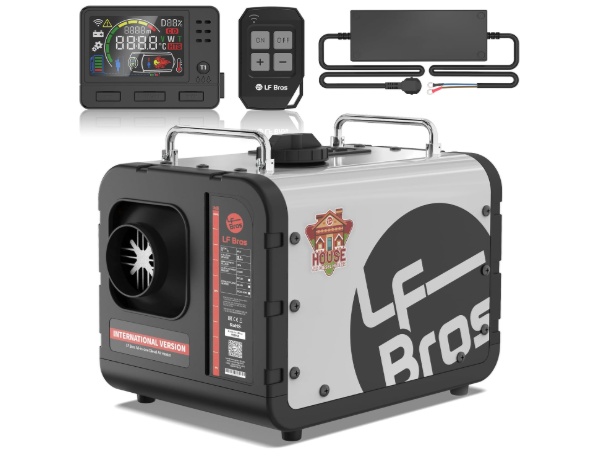
LF Bros Diesel Parking Heater
- 12V 24V 110V power options
- Remote control and LCD display
- Internal thread fuel tank cap
Where to Put a CO Alarm Near Your Diesel Heater
Carbon monoxide has no color or smell, so you cannot rely on your nose. A working CO alarm is the only early warning in a garage, camper, or shop.
Mount the alarm where its maker instructs, and keep it out of the direct path of the heater’s exhaust and intake air.
A colleague once asked me whether an alarm is still needed when the exhaust pipe runs outside. Yes, it is. A loose joint or a blocked pipe can still let fumes back in, and an alarm catches what a quick visual check misses.
Choose a model with battery power or battery backup. Test it monthly and replace it by the date printed on the unit.
If the alarm sounds, switch the heater off, get everyone into fresh air, and call emergency services. Do not restart the heater until a qualified person finds the cause.
Fuel Use and Runtime Rule for a Diesel Heater
- Read the spec sheet: Find the listed fuel use in liters per hour. Many 5 kW class heaters list roughly 0.18 to 0.53 liters per hour.
- Tank math: Divide tank liters by fuel use. A 5-liter tank at 0.5 liters per hour lasts about 10 hours.
- Low setting: At 0.2 liters per hour, the same tank stretches to about 25 hours.
- Plan for the short number: Cold air, wind, and poor insulation push the heater toward higher settings, so budget for the shorter runtime.
- Refill habit: Check the tank before a long job or before sleep. Refill only when the heater is off and cool.
- Spare fuel: Keep clean diesel in an approved container so you never top up in a rush.
LF Bros 5KW All-in-One Diesel Heater for Garage Camper and Shop Use
This lf bros diesel heater review recommendation fits users who want dependable diesel heat without complex installation. The all-in-one 5L design supports 110V, 12V, and 24V power, making it practical for home garages, workshops, RVs, and camping setups.
Features like the LCD screen and remote control allow precise temperature adjustment, while the sealed combustion system improves safety when properly vented. Its compact build also makes it easier to move or store between seasons.
Our pick is the LF Bros Diesel Parking Heater for garage and workshop heating, since it takes 12V, 24V, or 110V power and ships with a remote. →
What Causes Performance Differences Between LF Bros Models
Performance differences between LF Bros models, such as the N2, N3, Pro, and 8KW versions, are caused by airflow capacity, burner size, and controller programming.
Larger models move more air, which helps heat bigger spaces but increases fuel use and noise. Smaller units deliver steadier heat in enclosed or insulated areas. Fuel pump timing also matters. Poor calibration leads to rough startups or smoke, while newer controllers improve ignition stability.
Altitude plays a role as well. Reduced oxygen affects combustion, which is why plateau or high-altitude settings help prevent soot buildup. Power input flexibility also impacts reliability. Models supporting 110V, 12V, and 24V handle voltage variation better during startup.
These factors explain why one setup performs smoothly while another struggles, even with similar heaters.
How to Choose the Right LF Bros Diesel Heater for Your Space
For a small to medium garage with moderate insulation, a 5KW LF Bros diesel heater is usually sufficient. It provides stable heat without excessive fuel use or airflow noise.
In RVs or campers, portability and control matter more than maximum output. All-in-one LF Bros camping diesel heaters reduce installation complexity but must be positioned carefully for safe exhaust routing. Remote control and LCD screens improve usability in compact layouts.
Large or poorly insulated workshops may benefit from an 8KW model, but only if airflow paths allow heat to circulate properly. Oversized heaters often cycle inefficiently and waste fuel. High-altitude users should prioritize models with altitude adjustment to maintain clean combustion.
How to Set Up an LF Bros Diesel Heater Safely and Correctly
Step 1: Place the heater on a stable, vibration-free surface.
Step 2: Route the exhaust pipe fully outdoors with minimal bends and heat clearance.
Step 3: Position the air intake in a clean, fresh-air area away from fumes.
Step 4: Prime the fuel line and ensure the filter direction is correct.
Step 5: Use the correct voltage input to avoid startup errors.
Most performance complaints are traced to rushed installation rather than equipment failure.
LF Bros Diesel Heater Problems and What Usually Causes Them
Smoke during startup or running usually points to poor fuel quality or a clogged exhaust. Use clean diesel, then check the exhaust pipe for soot or a crushed bend before you blame the burner.
A ticking sound from the fuel pump is common at startup, and it should settle once the fan ramps up. If the noise stays loud, check that the heater sits on a stable surface and that nothing is loose. If it continues, contact the seller’s support.
Fan noise also rises on higher settings. A heater that sounds louder at full power is not necessarily faulty, so drop one level when you want it quieter.
Weak starts and LCD error codes often trace back to low supply voltage, air in the fuel line, or restricted airflow. Check the power connection and the fuel line first.
Users sometimes mention that the fuel level reading on the display drifts after the first tank. Treat it as a rough guide and look at the tank yourself before a long run.
Habits That Shorten Your LF Bros Diesel Heater Life
Running the heater only on its lowest setting for long periods can let carbon build up in the burner. Raise the output now and then so the heater can burn off residue.
A weak power source is the next common problem. Thin cables or a tired battery force the glow plug to work harder on every start, so use a solid supply and check the connections.
Loose or poorly sealed exhaust joints cause odor and corrosion over time. Reseal them as soon as you notice a smell instead of waiting for the next season.
Finally, do not treat the heater as maintenance-free. Use only diesel in the tank, as the manual states, and keep the intake clear of dust and clutter.
Accessories and Spare Parts Worth Having
- Exhaust pipe and heat sleeve: Gives the exhaust a safe, sealed path and keeps heat away from nearby materials.
- Smooth duct hose: Keeps airflow steady and avoids uneven heating from sharp bends.
- Muffler: Reduces exhaust noise in tight spaces such as campers.
- Intake and fuel filters: Protect the burner and pump from dust and dirty fuel.
- Spare glow plug: Useful if hard starts begin to appear after a few seasons.
- Controller extension: Lets you place the display where it is easy to read.
- Spare fuel pump: Worth considering if you heat in remote areas.
- Carrying case: Helps with storage and moving the heater between seasons.
Maintenance Routine for Long-Term Heater Reliability
Run the heater at higher output from time to time. This burns off residue and keeps the burner cleaner between heavy-use periods.
Inspect the exhaust and intake paths on a regular schedule. Look for soot, loose clamps, and blockages, since small restrictions cut heat output and cause odor.
Use clean diesel and replace the fuel filter when needed. Dirty fuel is one of the most common reasons for smoke and rough running.
At the end of the season, wipe the unit down and store it somewhere dry. Moisture is what damages the electrical connections, so keep the heater out of damp sheds and garages.
- More Posts You May Like: Are Vornado Heaters Energy Efficient and Worth It for Whole Room Heating
FAQs
Is the LF Bros diesel heater safe for garage use?
When properly vented outdoors and installed with clearance, LF Bros diesel heaters are commonly used in garages. Safety depends on exhaust routing, airflow, and fuel handling rather than the heater brand itself.
What is the difference between the LF Bros 5KW and 8KW models?
The main difference is airflow and fuel capacity. An 8KW heater moves more air and consumes more fuel. In smaller spaces, a 5KW model often performs more efficiently.
Do LF Bros diesel heaters work at high altitude?
Standard models may struggle without adjustment. Units with plateau or altitude settings reduce fuel delivery to maintain cleaner combustion and stable ignition.
Why does the heater smell during startup?
Startup odor usually comes from incomplete combustion caused by low voltage, air in the fuel line, or restricted exhaust flow.
How long does an LF Bros diesel heater last?
With correct installation and routine maintenance, many users report several seasons of reliable operation. Fuel quality and operating habits strongly influence lifespan.
