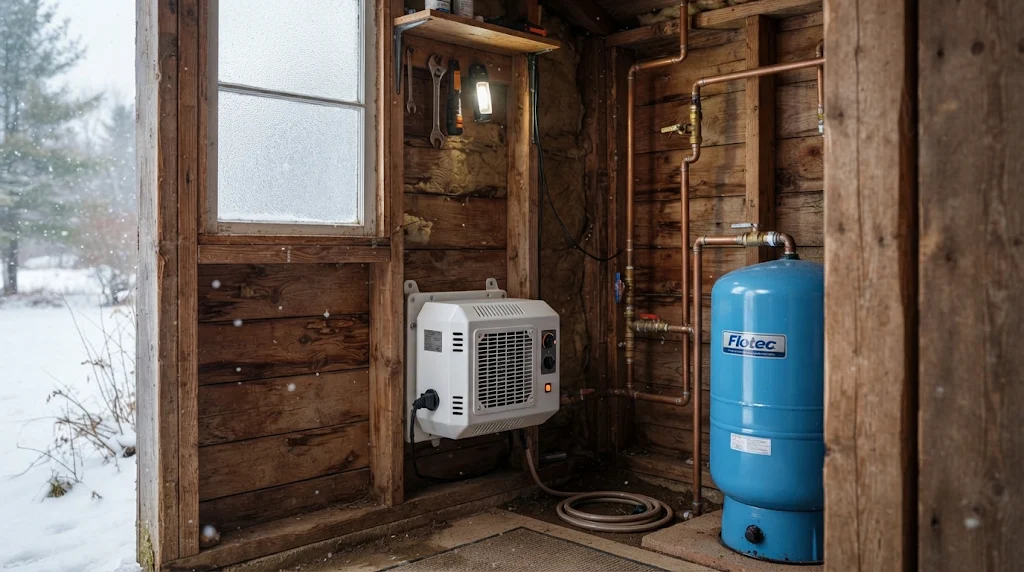
5 Best Pump House Heaters With Thermostats Reviewed

Disclosure: As an Amazon Associate, I earn from qualifying purchases. Learn more
Winter rarely knocks before it slips into a pump house. That quiet chill is what the AEGONAN Pump House Heater is built to meet, with 600 watts of convection heat and a built-in thermostat that holds a small room above freezing so your water keeps moving.
If you have ever walked out on a January morning to a dead pressure switch or a split fitting, you already know the stakes. The real questions are simple: how many watts your space needs, whether your circuit runs 120V or 240V, and how the heater handles damp, unattended conditions.
We kept this list to heaters made for pump houses, well houses, and utility rooms, so each one fits the job instead of a living room.
For steady freeze protection, the AEGONAN Pump House Heater brings digital temperature control on 120V, while the KING U2475 Utility Heater suits 240V pump rooms with damp conditions.
For Digital Temperature Control
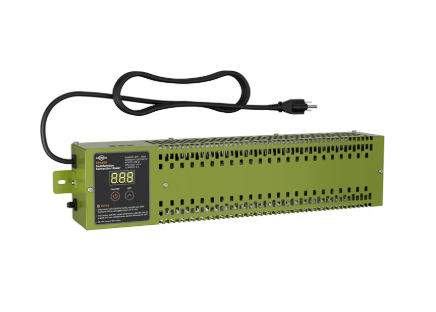
AEGONAN Pump House Heater
- 600W convection heat
- 40℉–105℉ digital thermostat
- X-shaped aluminum fins
For 240V Damp Locations
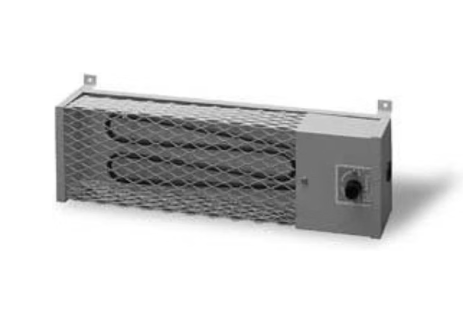
KING U2475 Utility Heater
- 750 watts at 240 volts
- Incoloy 840 heating element
- ETL damp location claim
Why Pump Houses Freeze Faster Than You Expect
A pump house is small, often thinly built, and sits close to cold ground. It has no living space around it to share warmth, so the inside temperature tracks the outdoors far more closely than a basement does.
Water sits still in the pressure tank, the pump housing, and short runs of exposed pipe. Still water freezes sooner than moving water, and the fittings and pressure switch are usually the first parts to crack.
Wind makes it worse. Gaps around the door, vents, and pipe entries let cold air sweep across the equipment, so a night that feels mild in the yard can still drop the inside of the shed below freezing.
How These Freeze Protection Heaters Were Chosen
Every heater here is described as a pump house, well house, or utility heater, not a living room heater pressed into service. That matters because these units are meant to sit low, run for weeks, and cycle on their own.
We looked for a built-in thermostat that reaches the low 40s, a heating method suited to small enclosed rooms, and listed details on power, coverage, and construction. Voltage mattered too, so the list covers both 120V and 240V setups.
We also kept one heater per brand, so you can compare different designs instead of near copies of the same unit.
Best Pump House Heater Picks Reviewed
1. AEGONAN Pump House Heater With a Digital Thermostat
This 600-watt convection heater is listed for pump houses, well houses, and utility rooms, and it reads as a well house heater with thermostat control rather than a general room unit.
The built-in thermostat has a digital display and a 40℉ to 105℉ range. X-shaped aluminum fins spread heat by convection, and there are no fans or moving parts to wear out.
A current overload protector and a thermal cut-off fuse add two layers of protection.
Real-Use Fit: It suits a small 120V pump house where you want to see the room temperature at a glance and set a low hold point.
Feature Spotlight:
- Digital display shows room temperature or the preset value
- Finned convection design with no moving parts
Core Strengths:
- Easy to set a precise low temperature
- Quiet operation with no fan
- Two built-in protection devices
Fits Best With:
- 120V circuits in pump or well houses
- Utility rooms and construction sheds
Before You Choose: The listing does not mention a UL, ETL, or CSA safety listing, so check the manual for clearance and mounting details.
2. KING U2475 Utility Heater for 240V Damp Pump Rooms
Built for a 240-volt supply, this 750-watt unit comes from a maker that has long focused on utility and freeze protection heaters. It is a slim body, listed at 5 x 3 x 17 inches and 5 pounds.
Its listing claims an ETL listing for use in damp locations, which counts for a room that sweats every thaw. The element is Incoloy 840, a corrosion-resistant alloy.
The thermostat offers frost protection from 40° to 90°F.
Real-Use Fit: As a pump house heater with thermostat control from 40° to 90°F, it fits owners who already have 240V power at the well.
Feature Spotlight:
- Damp location listing claim from ETL
- Corrosion-resistant Incoloy 840 element
- Meets ASSE-1060 requirements, per the listing
Core Strengths:
- Made for wet, cold utility spaces
- Slim shape fits tight wall space
- Low frost protection setting
Fits Best With:
- 240V circuits at the pump house
- Rooms with backflow or valve equipment
Before You Choose: This model runs on 240 volts only. If your pump house has only a standard 120V outlet, choose a 120V heater instead.
3. GMKYH Digital Utility Heater for Compact Well Rooms
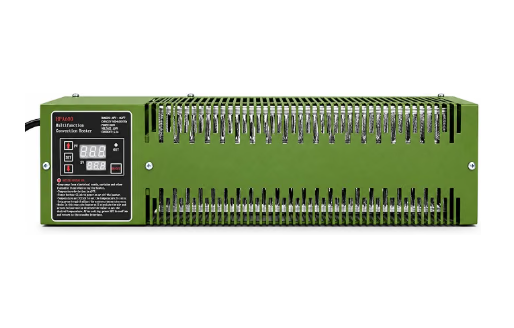
Small well rooms rarely need much heat, and this 600-watt, 120-volt heater is listed for 80 to 110 square feet. That range covers most compact pump houses with room to spare.
It uses an electronic thermostat with a digital display, set anywhere from 40°F to 105°F, plus overheat protection. At 5.1 pounds, it is easy to handle during mounting.
Real-Use Fit: It works well for a modest, fairly tight pump house on a 120V outlet where you want a readable temperature setting.
Feature Spotlight:
- Electronic thermostat with digital display
- Listed coverage of 80 to 110 square feet
Core Strengths:
- Right-sized output for small rooms
- Clear temperature readout
- Overheat protection included
Fits Best With:
- Standard 120V pump house outlets
- Small insulated well houses
Before You Choose: This is a newer listing, and it does not mention a UL, ETL, or CSA safety listing.
4. Dufakx Well House Heater for Larger Pump Rooms
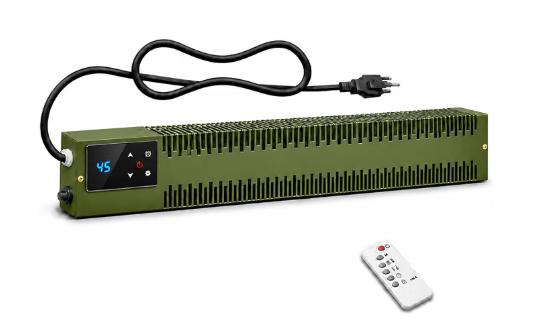
When a pump room is a little bigger or leakier, extra output helps. This well house heater delivers 1,000 watts on 120 volts, the most of any 120V pick here, with a listed coverage of 100 square feet.
It heats by convection and adds a digital display, an electronic thermostat, and overheat protection. The body is long and low, listed at 31 inches wide and 4.4 pounds.
Real-Use Fit: It makes sense for a drafty or less insulated pump room where a 600-watt unit may run without a break on the coldest nights.
Feature Spotlight:
- 1,000 watts of output on 120 volts
- Digital display with electronic thermostat
Core Strengths:
- More heat for harder freezes
- Works on common household voltage
- Overheat protection built in
Fits Best With:
- Larger 120V pump rooms
- Well houses with long wall space
Before You Choose: At 31 inches wide, it needs a clear stretch of wall. The listing does not mention a UL, ETL, or CSA safety listing.
5. Qmark WHT500 Utility Heater With Tamper-Proof Controls
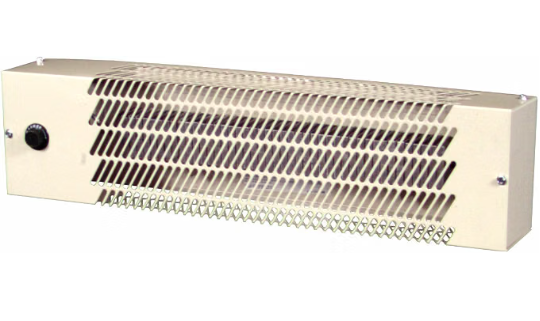
Set it once and leave it alone. That is the idea behind this 500-watt, 240-volt heater, whose thermostat sits inside a tamper-proof control box.
The cabinet is galvanized steel, chosen to hold up to the elements and temperature swings. The listing suggests installing it next to pipes and other fluid-filled machinery, and it measures 3.5 x 21 x 5 inches at 4.62 pounds.
Real-Use Fit: It suits a 240V well house where you want the setting protected from bumps or curious hands.
Feature Spotlight:
- Thermostat locked inside a tamper-proof control box
- Galvanized steel cabinet
Core Strengths:
- Setting stays where you leave it
- Steel body handles damp, cold rooms
- Compact enough to mount near pipes
Fits Best With:
- 240V well and pump houses
- Utility rooms with exposed piping
Before You Choose: It needs 240 volts, and the thermostat range is not shown on the listing, so confirm it in the manual.
Sizing Heater Watts for Your Well House
A pump house heater only needs to hold the room a few degrees above freezing, not make it comfortable. That is why freeze protection units run at low wattage compared with room heaters.
Going by the listed specifications, the five heaters here range from 500 to 1,000 watts, which fits small enclosed spaces rather than workshops or garages.
Three things push you toward the higher end of that range:
- Little or no insulation in the walls, roof, or door
- Drafty gaps around pipe entries and vents
- Long, hard winters with frequent subzero nights
A tight, insulated 4 x 6 foot pump house usually sits comfortably at the low end. A bigger room, or one with a loose door, may need closer to 1,000 watts.
Choosing Between 120V and 240V Heater Power
Check the power at your pump house before you pick a heater. Many well pumps run on 240V, but the outlet in the same building may be a standard 120V receptacle.
A 120V heater is the simpler choice when you have a normal outlet. A 240V model makes sense when that circuit is already in place, and it should be connected by someone qualified to work on it.
| Heater | Power | Thermostat |
|---|---|---|
| AEGONAN Pump House Heater | 600W, 120V | Digital, 40℉ to 105℉ |
| KING U2475 Utility Heater | 750W, 240V | Built-in, 40° to 90°F |
| GMKYH Digital Utility Heater | 600W, 120V | Electronic, 40°F to 105°F |
| Dufakx Well House Heater | 1,000W, 120V | Electronic, digital display |
| Qmark WHT500 Utility Heater | 500W, 240V | Tamper-proof control box |
Convection Heaters Versus Fan Heaters in Small Rooms
Convection heaters warm the air around them and let it rise and circulate on its own. With no fan, there is nothing to clog with dust or seize after months of damp air.
Fan-forced heaters move warm air faster, which helps in a larger room. In a small pump house, though, the fan is one more part that can fail, and many fan heaters are built for rooms people occupy, not sheds left alone all winter.
If you are weighing heating styles more broadly, this look at ceramic and convection designs explains how each spreads heat.
Thermostat Settings That Keep Well Pipes Safe
Set the thermostat low. A hold point around 40 to 45°F keeps water liquid without running the heater more than needed.
Check that the heater you choose actually reaches that low. Every thermostat in this list starts at 40°F, except the Qmark, whose range you should confirm in its manual.
A simple min/max thermometer inside the pump house shows you how cold it got overnight. If the low reading creeps toward freezing, add insulation or move up in wattage.
Where to Mount a Heater Inside the Pump House
- Place it low, since warm air rises and cold air settles near the floor and pipes.
- Aim it toward the pressure tank, pump, and exposed fittings, not an empty corner.
- Keep the clearances listed in the manual from walls, insulation, and stored items.
- Keep it away from spots where a leaking fitting or relief valve could spray it.
- Run the cord or wiring so it cannot be kinked, pinched by the door, or chewed.
Insulation Choices That Cut Heater Run Time
Insulation does more for your power bill than any heater feature. Rigid foam board on the walls and ceiling is a common choice for small pump houses because it resists moisture.
Seal the gaps around pipe entries and the door with foam or weatherstripping. A well-fitted door alone can stop a lot of cold air from sweeping across the equipment.
Leave the floor and any required vents as your well contractor or local code calls for. The goal is to trap heat without blocking access or creating moisture problems.
Mistakes That Lead to Frozen Well Lines
- Using a heater that is too small for a drafty, uninsulated room
- Setting the thermostat too high, which wastes power without adding protection
- Forgetting to test the heater before the first hard freeze
- Blocking the heater with stored buckets, bags, or tools
- Ignoring a tripped breaker after a storm or power flicker
Safe Use Habits for Unattended Utility Heaters
A pump house heater runs for weeks with nobody watching, so the setup matters. Read the manual and follow its clearance, mounting, and wiring instructions exactly.
Keep the room clear of fuel cans, rags, and other combustibles. Check the heater and cord at the start of each season for damage, corrosion, or loose connections.
If you want a wider view of which heater types hold up to long, unattended use, this guide on heaters safe to run overnight covers the key safety features.
Heat Lamps and Other Pump House Alternatives
Heat lamps show up often in older well houses. They put strong heat on one spot through an exposed bulb, which is why many owners prefer an enclosed convection heater for a room left alone all winter.
Other options can work alongside a heater:
- Heat tape on exposed pipe sections
- Insulated covers for small above-ground pumps and backflow devices
- Thermostatically controlled outlets that switch a plug-in heater on near freezing
If the same well also supplies livestock troughs, keeping that water open is a separate job, and a stock tank heater handles it better.
Who Should Skip a Dedicated Utility Heater
If your pump sits in a heated basement or an attached utility room, you likely do not need one at all. A submersible pump with buried lines below the frost line may also need little more than a covered, insulated pressure tank.
When the pump shares space with tools or a workbench you use in winter, a heater sized for a shed may serve both needs.
And if the pump room is part of a larger farm building, a heater built for barns is a better match for the space.
Common Questions About Well House Heaters
What temperature should a pump house heater be set to?
Most owners set it around 40 to 45°F. That is warm enough to keep water in the pressure tank, pump, and fittings from freezing, yet low enough that the heater cycles off for long stretches. Setting it higher adds little protection and raises running costs. Place a min/max thermometer near the pipes, then adjust the setting if the overnight low drops close to 32°F during cold snaps.
Can a pump house heater run all winter?
Yes, that is what these heaters are made for. A built-in thermostat switches the heater on and off as needed, so it does not run nonstop unless the room is too cold for its output. Check it at the start of the season, glance at it after storms, and make sure nothing has been stacked against it. A heater that never shuts off is usually a sign the room needs more insulation or more watts.
Do I need an electrician to install a 240V heater?
For a 240V unit, it is wise to have a licensed electrician make the connection. The circuit, breaker size, and wiring method must match the heater and your local electrical code. Mistakes on a 240V circuit can damage the heater or create a shock risk in a damp room. Plug-in 120V heaters are simpler, but the outlet should still be in good condition and rated for the heater’s load.
Will a pump house heater work during a power outage?
No. An electric heater stops the moment power goes out, and so does the well pump. In a long winter outage, the pump house can cool quickly. Some owners connect both the pump and heater to a generator through a properly installed transfer setup. Insulating the room and the pressure tank also buys valuable hours before the inside temperature reaches freezing again.
Can I use a regular space heater in a pump house?
It is possible, but it is not the best fit. Many household space heaters are designed for occupied rooms, with fans and controls meant for comfort rather than freeze protection. A pump house is damp, dusty, and left alone for weeks. Heaters listed for pump houses and utility rooms are built around low thermostat settings and long, quiet cycling, which suits the job better.
How do I know if my pump house is getting too cold?
The easiest way is a min/max thermometer placed near the pressure tank or lowest pipe. It records the coldest temperature reached, so you can see what happened overnight without being there. Some owners use a wireless sensor that sends alerts to a phone. If the low keeps dipping near 35°F, seal drafts, add insulation, or move to a heater with more output.
Picking the Right Heater Before the First Freeze
A dedicated heater makes sense for any standalone pump house that sees freezing nights. It will not make up for a room with no insulation, and none of these units works during a power outage.
A simple rule helps: match the heater to the power you already have, then choose the wattage your room’s insulation demands. For most small 120V pump houses, the AEGONAN Pump House Heater is the calm, sensible place to start.
