
5 Best Top-Rated Fireplace Fans (Updated)

Disclosure: As an Amazon Associate, I earn from qualifying purchases. Learn more
For most wood stoves, the JossaColar Heat Powered Stove Fan is the easiest pick, with quiet curved blades and a thermometer in the box. Heat rises on its own, and a small fan gives it somewhere to go.
You may have a stove that bakes the corner it sits in while the rest of the room stays cool. A heat-powered fan pushes that warm air outward without batteries or a cord, but it only works on the right surface. The points that matter most are your stove’s surface temperature, overheat protection, and how much air the blades actually move.
Below you will find quick picks, reviews, and clear advice on placement, safe temperatures, and when an electric blower makes more sense, plus ways to circulate fireplace heat through the house.
The JossaColar Heat Powered Stove Fan pairs curved aluminum blades with a magnetic thermometer, while the VODA Heat Powered Stove Fan adds eight blades for wider airflow on wood stoves.
For Everyday Wood Stoves
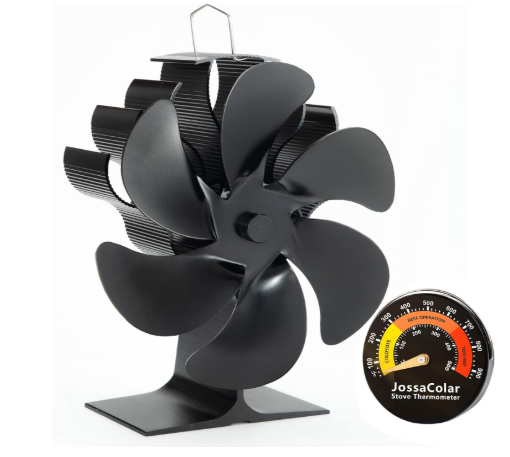
JossaColar Heat Powered Stove Fan
- Curved aluminum blades
- Magnetic thermometer included
- Runs below 25 dB
For Wider Room Airflow
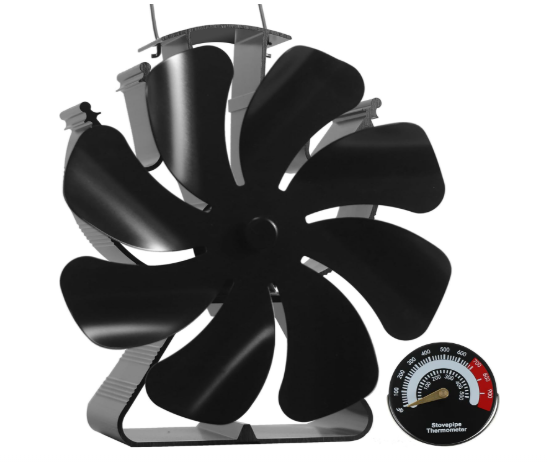
VODA Heat Powered Stove Fan
- Eight-blade design
- Starts near 140°F
- Aroma dispenser included
Advantages of Adding a Fireplace Fan to Your Stove
A wood stove heats the air around it, and that warm air tends to rise and pool near the ceiling. A heat-powered fan pushes it outward at the level where you sit.
Even warmth. Moving warm air away from the stove helps reduce the hot-near, cold-far feeling in a room.
No power needed. Heat-powered models run on the stove’s own heat, so there are no cords or batteries.
Quiet operation. Several picks below list noise levels under 25 dB.
The fans below were checked on their current listings, and only available models with steady buyer interest were kept. Older picks that are no longer sold were replaced.
1. JossaColar Heat Powered Stove Fan for Wood Stoves
This fan runs on heat alone, with no batteries or cord. Set it on a hot stove top and the warmth drives its motor, sending air across the room through curved aluminum blades that measure about 6.5 inches long on a 7.7-inch-tall frame.
JossaColar includes a free magnetic thermometer, lists operation below 25 dB, and backs the fan with a 1-year replacement promise for quality problems plus a 30-day refund window.
Everyday Use Notes
It suits living rooms and bedrooms where you want steady air movement without hearing the fan.
Notable Features
- Curved aluminum blades
- Magnetic stove thermometer included
- Listed under 25 dB
Why It Helps
- No electricity or batteries needed
- Spreads warm air away from the stove
- Thermometer helps avoid overheating
Fits Best With
- Wood burning stoves
- Log burners
- Fireplace inserts with flat tops
Fair Warning
It needs a flat, hot metal surface to spin. Check the thermometer often, since running any stove fan too hot can damage it.
2. VODA Heat Powered Stove Fan With Eight Blades
Eight blades set this VODA fan apart. They push a larger volume of warm air horizontally across the room instead of straight up, so the space warms more evenly.
VODA lists a working range of 176°F to 653°F, with the blades starting to spin around 140°F and running best near 482°F. A magnetic thermometer and an aroma dispenser for your own essential oils come in the box, along with a 12-month warranty.
Everyday Use Notes
It works well for anyone who wants wider airflow from a freestanding wood stove.
Notable Features
- Eight-blade design for more air volume
- Magnetic thermometer included
- Aroma dispenser for essential oils
Why It Helps
- Pushes heat outward rather than upward
- Starts spinning at lower temperatures
- Twelve-month warranty from the maker
Fits Best With
- Freestanding wood stoves
- Log burners
- Rooms needing wider heat spread
Fair Warning
VODA states this fan is not suitable for built-in fireplaces. Running above 653°F may damage the fan and its generator.
3. Tomersun Large Wood Stove Fan for Bigger Rooms
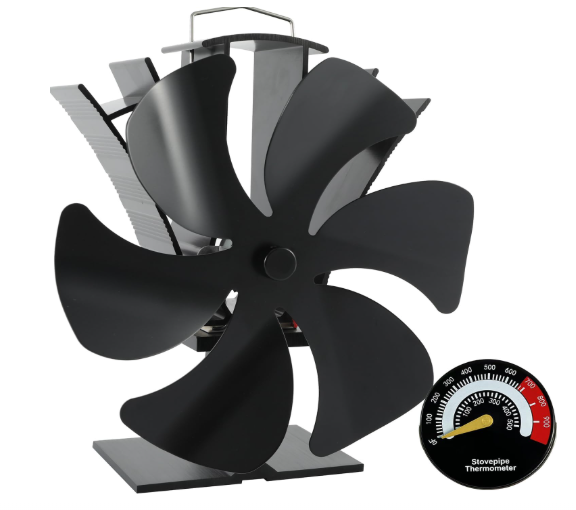
For larger spaces, Tomersun builds a 7-inch, 6-blade fan designed to move more air than compact four-blade models, helping warmth reach room corners.
A metal strip in the base lifts the fan automatically when it runs too hot, protecting the thermoelectric module. The included magnetic thermometer helps you keep the stove in the 392°F to 482°F range Tomersun recommends, and the aluminum body has an electrophoretic coating that resists discoloration and rust.
Everyday Use Notes
It fits larger stoves and open rooms where a small fan feels underpowered.
Notable Features
- Large 7-inch six-blade design
- Auto-lift overheat protection
- Coated aluminum body resists discoloration
Why It Helps
- More airflow than compact fans
- Protects itself from excess heat
- Quiet with no cords or batteries
Fits Best With
- Wood burning stoves
- Log burners
- Indoor fireplaces with a flat metal top
Fair Warning
Tomersun advises avoiding sustained use above 572°F. Older photos of this listing may show a different blade count than the current model.
4. COMBIUBIU Wood Stove Fan With Four Wide Blades
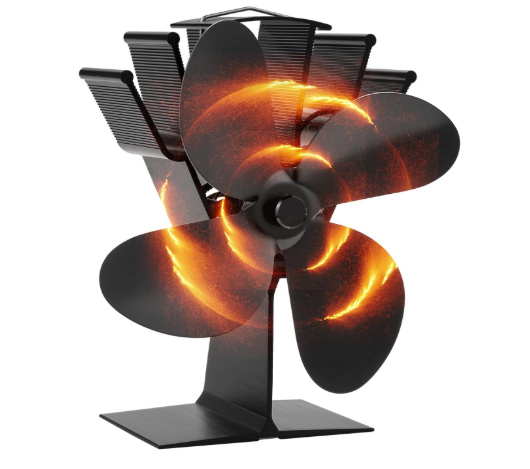
Simplicity is the appeal here. There is no assembly, so you just set the fan on top of the stove and it starts spinning as the surface heats.
Its four blades are shaped to create a broad thermal current, and COMBIUBIU describes the operation as virtually silent. The listed working range is 176°F to 482°F, and the maker warns not to exceed 662°F.
Everyday Use Notes
It suits anyone who wants a straightforward fan that is ready to use out of the box.
Notable Features
- Four broad blades
- No assembly required
- Listed as virtually silent
Why It Helps
- Works without batteries or power
- Quick setup on any flat stove top
- Helps raise room temperature faster
Fits Best With
- Wood burning stoves
- Fireplace stoves
- Small to medium rooms
Fair Warning
No thermometer is mentioned in the listing, so a separate stove thermometer is a smart addition.
5. HIDALIFE Wood Stove Fan With Mounting Bracket
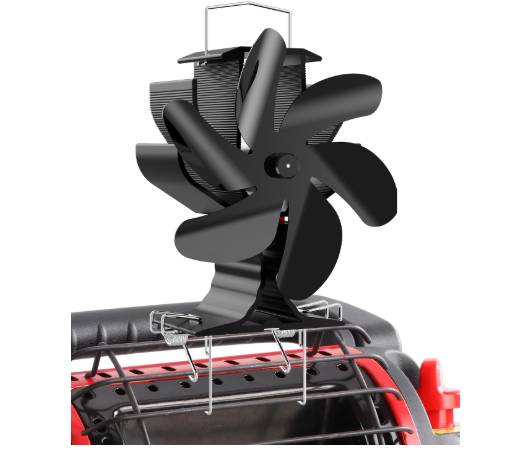
The HIDALIFE fan is built from anodized aluminum, a rust-resistant material that conducts heat well. It measures about 3.5 by 3.5 by 7.9 inches, so it fits smaller stove tops.
The listing notes a 25 dB noise level, a speed of about 1,100 RPM, overheating protection, and a special bracket included for mounting.
Everyday Use Notes
It works for smaller stoves and heaters where a compact fan with a bracket helps.
Notable Features
- Anodized aluminum construction
- Mounting bracket included
- Overheating protection
Why It Helps
- Compact size for small stove tops
- Quiet 25 dB operation
- Rust-resistant body
Fits Best With
- Small wood stoves
- Compact heaters with a hot flat top
- Offices and small rooms
Fair Warning
The listing gives fewer details on temperature range than other picks. Check the included instructions before mounting it on any heater.
How Heat-Powered Stove Fans Actually Work
A heat-powered fan uses a thermoelectric module in its base. When the bottom is hot and the top fins stay cooler, the temperature difference produces a small electric current that spins the motor.
That is why the fan speeds up as the stove gets hotter and slows as it cools. It also explains why cooling fins matter, since the fan needs a clear temperature difference to work.
Going by the listed specifications, the VODA fan starts spinning around 140°F, while the Tomersun and COMBIUBIU fans list a start point near 176°F.
These fans do not create heat. They move the warm air your stove already produces. For a broader look at this category, see our guide to heat powered wood stove fans.
Stove-Top, Flue-Mounted, and Magnetic Fireplace Fans Compared
Stove-top fans. These sit on a flat stove top and are the most common type. Every pick in this guide is designed mainly for stove-top use.
Flue-mounted fans. These clamp or hang on the stove pipe. They suit stoves with curved or crowded tops, but stove pipes can run hotter than the top, so check the fan’s temperature limit carefully.
Magnetic fans. Magnetic stove fans attach to steel stove pipes or surfaces with a magnet. They save top space but only work on magnetic steel, not on cast iron with enamel or other non-magnetic finishes.
Whatever the style, the fan must sit on a surface within its working temperature range.
Fireplace Blower Kits and Electric Fans Explained
Blower kits. Many gas fireplaces, fireplace inserts, and factory-built fireplaces accept an electric blower kit. It pulls room air through channels around the firebox and pushes it back out warm. Kits are model-specific, so use the one your fireplace maker lists.
Thermostat control. Some blower kits include a thermal switch that turns the blower on once the firebox warms up and off as it cools.
External fans. A small electric fan placed at floor level in the next room, pointed toward the fire room, can also help move heat. Keep it well away from the hearth.
If you heat with gas, read our tips on getting more heat from a gas fireplace.
Do Heat-Powered Fans Work on Open Fireplaces
Usually not well. A heat-powered fan needs a flat, hot metal surface. An open masonry fireplace rarely offers one, and placing a fan on brick or the hearth floor will not get it hot enough to spin properly.
VODA, for example, states that its fan is not suitable for built-in fireplaces. For an open fireplace, a fireplace insert with a blower or room fans that move air between spaces are better options.
Heat-powered fans work best on freestanding wood stoves, pellet stoves with hot flat tops, and wood-burning inserts.
Choosing the Right Fan for Your Stove
Working temperature range. Match the fan’s range to your stove. A fan that starts at a lower temperature spins sooner on smaller fires.
Blade count and size. More or larger blades move more air but may need more heat to reach full speed. Large fans suit big rooms, while compact fans suit small stove tops.
Overheat protection. A bimetal strip that lifts the fan when it gets too hot protects the thermoelectric module.
Thermometer. An included stove thermometer helps you keep the fan in its safe range.
Noise. Most heat-powered fans are quiet, and several list levels under 25 dB.
Where to Place a Stove Fan for the Best Airflow
Toward the back or side of the stove top. This position lets the fan draw cooler air from behind and push warm air forward into the room. Follow your fan maker’s placement advice, since designs differ.
Away from the flue collar. The area right next to the stove pipe can run hotter than the rest of the top, which may push the fan past its limit.
Facing the room you want to warm. Point the blades toward the main seating area or an open doorway.
On a flat, clean surface. Full contact between the fan base and the stove top gives the best heat transfer and steady speed.
Working Temperatures, Overheat Protection, and Safe Limits
Every heat-powered fan has a safe working range, and the listed limits differ by model:
- VODA: works from 176°F to 653°F and runs best near 482°F.
- Tomersun: best between 392°F and 482°F, with sustained use above 572°F to avoid.
- COMBIUBIU: works from 176°F to 482°F, never above 662°F.
A magnetic stove thermometer placed near the fan shows when the surface is getting too hot. If it climbs past the fan’s limit, lift the fan off with a glove and let the stove cool.
Decorative Fireplace Fans Versus Working Stove Fans
A decorative fireplace fan is usually a folding, fan-shaped screen in brass, copper, or black metal that stands in front of an unused fireplace opening. It looks attractive but does not move air.
A working stove fan has blades and a motor that circulate warm air. If you want more heat in your room, choose a heat-powered or electric fan rather than a decorative screen.
Never place a decorative screen in front of a burning fire unless it is rated as a fire screen.
Cleaning and Caring for a Heat-Powered Fan
Let it cool first. The base gets very hot, so handle the fan only after it has cooled, or use a heat-resistant glove.
Dust the blades and fins. A soft brush or dry cloth keeps blades and cooling fins clear, which helps the fan run efficiently.
Avoid water on the motor. Wipe the base with a barely damp cloth if needed, and keep moisture away from the motor.
Store it in summer. Keep the fan in its box or a dry cupboard during the off-season to protect the blades from bending.
Mistakes That Shorten a Stove Fan’s Life
- Leaving it on a stove that runs far above its limit, which can damage the thermoelectric module.
- Placing it on an uneven or non-metal surface, where it cannot draw enough heat.
- Setting it right against the stove pipe, where temperatures spike.
- Grabbing a hot fan with bare hands, which can cause burns.
- Expecting one small fan to heat a whole house. It helps spread heat in the room the stove is in.
Safe Wood Burning Habits That Help Any Fan
A fan works best when the stove burns cleanly and steadily. The EPA advises that wood burns best at a moisture content under 20 percent, which means hotter fires and less smoke.
Burn seasoned wood. Dry wood gives a steady stove temperature that keeps your fan spinning.
Keep clearances. Keep anything that can burn at least 3 feet from the stove, and keep the stove door closed except when loading wood.
Have the chimney checked yearly. The U.S. Fire Administration’s wood stove safety tips also recommend a yearly chimney inspection and storing ashes in a covered metal container outdoors.
Our guide to non-electric wood stove fans covers more options for cordless setups.
Common Questions About Fireplace and Stove Fans
Can You Use a Fireplace Fan Without a Fire?
A heat-powered fan will not run without a fire, because it needs a hot stove surface to generate power. It sits still on a cold stove. An electric fireplace blower can run without a fire, but it only moves room air and does not add heat. If you want air movement when the stove is off, a regular room fan or ceiling fan on its winter setting is the simpler choice.
Do Heat-Powered Fans Really Make a Room Warmer?
They do not create heat, but they can make a room feel warmer by moving hot air away from the stove and into the space where people sit. Without a fan, much of that heat rises to the ceiling. Results depend on room size, stove heat, and fan design. Expect a noticeable improvement in the stove room, not whole-house heating.
Will a Stove Fan Work on Gas or Pellet Stoves?
It can if the stove has a flat metal top that gets hot enough to reach the fan’s starting temperature. Many pellet stoves and gas stoves run cooler on top than wood stoves, so the fan may spin slowly or not at all. Check the fan’s working range and your stove manual. Never place a fan on vents, glass, or plastic parts.
How Long Do Heat-Powered Stove Fans Last?
With careful use, a heat-powered fan can last several heating seasons. The most common cause of early failure is overheating, which damages the thermoelectric module or motor. Keeping the stove within the fan’s listed range, using a thermometer, and choosing a model with an auto-lift overheat strip all help. Keep blades clean, handle the fan gently, and store it in a dry place during summer.
Are Fireplace Fans Noisy?
Heat-powered stove fans are generally very quiet. Several models in this guide list noise levels at or below 25 dB, which is close to a whisper. You may hear a faint hum at higher speeds. Electric blower kits are louder because they use a powered motor, though many include speed or thermostat controls that help keep noise down. Placement on a flat surface also prevents rattling.
Do I Need a Thermometer with a Stove Fan?
A thermometer is not required, but it is very useful. Each fan has a maximum operating temperature, and going over it can damage the fan. A magnetic stove thermometer placed near the fan shows the surface temperature at a glance. Several picks here include one in the box. If yours does not, a separate stove thermometer is an inexpensive way to protect the fan.
Picking a Fireplace Fan That Fits Your Stove
A heat-powered fan is a simple, quiet way to spread stove heat across a room, as long as it sits on a hot, flat metal surface within its working range. For open fireplaces, a blower kit, an insert, or room fans are better options.
A simple rule helps: choose a fan with an included thermometer and overheat protection, and match its size to your stove and room. For most wood stoves, the JossaColar Heat Powered Stove Fan is the overall pick, with quiet operation and a thermometer to keep it in a safe range.
