Is the Handy Heater Safe Indoors and What Risks to Know

Disclosure: As an Amazon Associate, I earn from qualifying purchases. Learn more
Yes, a handy heater can be safe indoors when you use it as supplemental heat, set it on a hard, level surface, and plug it straight into a wall outlet. The bigger risk usually comes from how and where it runs, not from the box it came in.
Maybe one showed up as a gift before a cold snap, or you spotted it on a shelf and wondered whether a heater that small can start a fire. That question is fair, since space heaters of every brand are tied to house fires each winter.
The worries people raise most are heat too close to bedding or curtains, running the heater while asleep, and overloaded cords or outlets. Below you will find what the Ontel Handy Heater Pure Warmth lists, which habits matter most, and how to set it up in a bedroom, office, or basement.
The Ontel Handy Heater Pure Warmth pairs 1200W ceramic heat with three settings and a removable filter, aimed at personal warmth in bedrooms and offices.
For Desk and Bedside Warmth
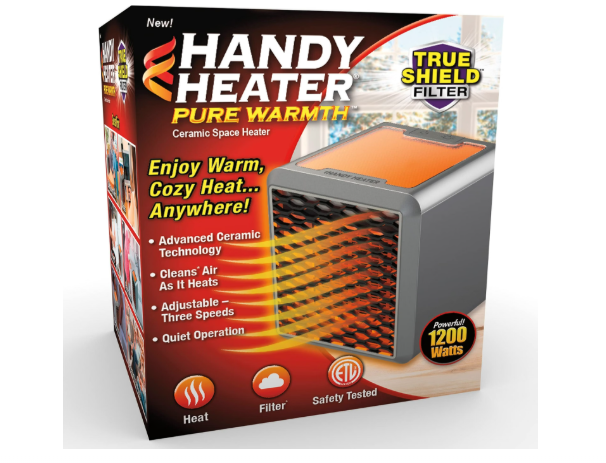
Ontel Handy Heater Pure Warmth
- 1200W ceramic heating
- Three heat settings
- Built-in removable filter
- Stay-cool housing
What Makes a Handy Heater Safe or Risky at Home
Safety with any portable heater rests on two things: what the unit does on its own, and what you do around it. Handy Heater is a brand name used on several small electric heaters, and the one covered here, the Pure Warmth, is a compact ceramic model that blows warm air forward.
A heater is safer when it has an automatic shut-off, a stay-cool housing, and a certification mark from a recognized testing lab, sits on a hard, level floor, and has open space around it. It turns risky when a blanket, curtain, or couch cushion ends up near the front grille, or when it runs for hours in an empty room.
Think of a kitchen toaster. It is not dangerous on the counter, yet a paper towel left on top changes everything.
So the answer is conditional. Treat the heater as supplemental heat that needs your attention, three feet of clear space, and a wall outlet that can carry the load. If any of those pieces is missing, the risk climbs no matter which brand is on the box.
Ontel Handy Heater Pure Warmth Safety Features Up Close
The Pure Warmth is a compact plug-in ceramic space heater sold for personal warmth in bedrooms, offices, and playrooms. Its listing also describes a built-in auto shut-off and a removable filter behind the housing.
The maker says the surrounding air warms by about 20°F within minutes and that the ceramic design helps keep moisture in the air. Treat those as the maker’s claims rather than measured results.
Customer Impressions: Owners describe strong heat for its size and a compact body they can place almost anywhere. Feedback on noise and durability is mixed, and some owners report flames coming from the unit.
Notable Features:
- Removable filter for catching dust
- Lightweight body that frees up floor space
Core Strengths:
- Warms your spot without heating the whole house
- Low setting gives a gentle starting point
- Small enough for a desk or nightstand
Suited To:
- Bedrooms, offices, and playrooms
- Direct wall outlet connections
- Hard, level surfaces with open space
Limits To Keep In Mind: Owner reports of flames and early failures mean you should watch it closely, keep three feet clear, skip bathrooms, and never run it while asleep.
Why Space Heater Fire Worries Keep Coming Up
Most worry around portable heaters has real roots. Federal safety estimates tie portable heaters, including electric space heaters, to an average of 1,700 fires a year from 2017 to 2019, with an average of 70 deaths and 160 injuries annually. Those numbers cover every brand, so they say more about habits than about one product.
Cause: flammable items too close. Drapes, bedding, and sofa arms can ignite when they sit in the path of hot air. Effect: a smoldering fire that starts quietly and spreads before anyone notices.
Cause: extension cords and power strips. Going by the listed specifications, the Pure Warmth draws 1200 watts, roughly 10 amps on a standard 120-volt outlet, which leaves little spare room on that circuit. Effect: a cord or plug that overheats, melts, or trips the breaker.
Cause: running while you sleep or leave. Nobody is watching if a pet bumps the unit or a cord shifts. Effect: a small problem grows with no one around to stop it.
Cause: dust buildup and worn cords. Lint inside a fan heater can burn with a sharp smell, and frayed insulation can spark. Effect: odors, tripped breakers, or an electrical fault.
Almost every cause is something you control. Built-in safety features act as a backup, not a replacement for good placement and attention.
Built-In Safety Features and What They Cannot Do
A feature list only helps when you know what each item covers. Here is what common space heater safety features do on their own.
| Feature | What It Covers |
|---|---|
| Auto shut-off | Cuts power after a detected fault |
| Stay-cool housing | Keeps the outer case cooler to touch |
| Tip-over switch | Stops heat if the unit falls |
| Thermostat | Cycles heat to hold a set temperature |
| Certification mark | Shows a lab tested the design |
None of these notice a blanket sliding toward the grille or a cord working loose. Fire safety officials also advise buying heaters tested and labeled by a recognized lab, so look for that mark on the unit or box before relying on it. This look at how ceramic heaters stay safe covers the heating element side.
If you cannot find a lab mark on your unit, consider compact heaters with listed certification instead.
Handy Heater Models Differ in Ways That Matter
The Handy Heater name appears on more than one product, from small plug-in wall units to tabletop ceramic heaters like the Pure Warmth. Wattage, controls, and safety features can change from one model to the next.
That matters because advice written for one model may not fit yours. A plug-in wall unit sits right at the outlet, while a tabletop model needs desk or floor space and a clear zone around it.
Read the label on the back or bottom of your heater for the model name and wattage, then match it to the manual. If a feature such as a thermostat, timer, or tip-over switch is not described in the manual, do not assume it is there.
At least one owner reports a replacement unit arriving without the filter shown in the listing, so compare what you received with the description. If you are still choosing, these personal heater options show other compact designs.
Warning Signs That Mean Unplug the Heater Now
Not every smell or click means danger, but some signs call for an immediate unplug. Match what you notice with its likely cause.
Light dusty smell in the first minutes: dust burning off the element. Ventilate the room and stay nearby.
Lingering plastic or electrical smell: an overheating cord, plug, or housing. Unplug at once and stop using it.
Warm or discolored plug or outlet: a loose connection or an overloaded circuit. Unplug and have the outlet checked.
Breaker trips again and again: too many devices on one circuit. Move to a less crowded outlet.
Sparks, flames, or popping sounds: damaged wiring or an internal fault. Unplug only if you can do so safely, and never use it again.
Scorch marks on nearby fabric: items placed too close. Clear the area and stop use until checked.
Normal behavior is steady warm airflow from the front grille. Keeping the intake clean helps, and these ceramic heater cleaning steps cover the basics. If you ever see smoke or flames, leave the room, close the door behind you if it is safe, and call 911.
How to Set Up a Handy Heater Safely Indoors
Setup takes a couple of minutes and removes most of the risk before the heater ever warms up. Follow these steps each time.
1. Check the model and recalls. Confirm the model name on the label and look it up in the federal recall database at the start of each cold season.
2. Inspect the heater and cord. Look for cracks in the housing, bent prongs, or frayed insulation. If anything looks damaged, do not plug it in.
3. Choose a hard, level spot. Avoid beds, couches, stacked boxes, and thick rugs, because an unstable base is how tip-overs happen.
4. Clear three feet on every side. Keep curtains, bedding, paper, clothing, and furniture back from the front, sides, and rear.
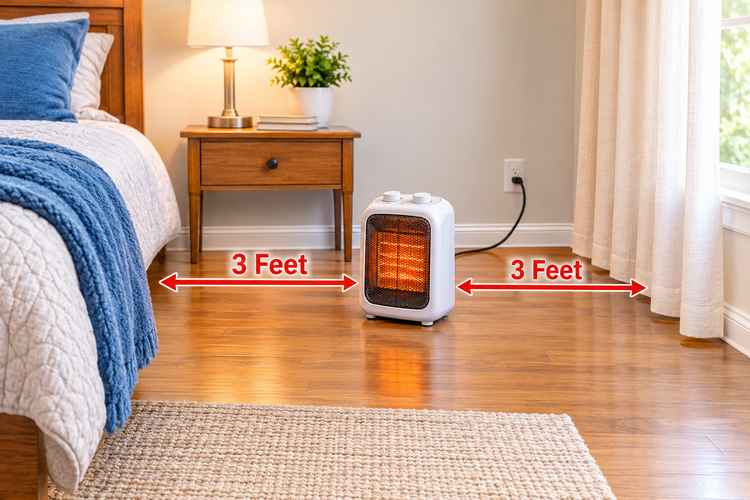
5. Plug straight into a wall outlet. Skip extension cords and power strips, and avoid sharing that outlet with a hair dryer, microwave, or other high-wattage device.
6. Start on the lowest setting. Move up only if you need more warmth.
7. Check the plug after ten minutes. Gently feel the plug and cord with the back of your hand. Warm is acceptable, but hot means unplug it and stop.
8. Know your switch-off plan. Turn it off and unplug it before you leave or sleep, then let it cool before moving or storing it.
Pair the routine with working smoke alarms, tested once a month, so a mistake never goes unnoticed.
Is the Handy Heater Safe to Leave On Overnight
It is 11 p.m., the bedroom feels icy, and falling asleep with a heater humming nearby seems like the easy fix. The guidance here is consistent. Turn portable heaters off and unplug them before you go to sleep.
That holds even though the Pure Warmth listing mentions quiet operation for sleep. Federal safety officials say never to leave portable heaters on while sleeping, and that advice covers every brand.
Shut-off features respond to specific events. They do not notice a comforter sliding toward the grille, a cat settling in front of it, or a cord slowly working loose. While you sleep, nobody can react in the first minute, when a fire is easiest to stop.
You still have options. Warm the room first for twenty or thirty minutes while you read, then switch it off and unplug it. Add a heavier blanket, seal window drafts, and wear warm socks.
Fire safety groups also suggest sleeping with the bedroom door closed, since a closed door slows smoke and heat. Test your smoke alarms monthly so that habit has a working warning behind it.
Keeping Kids, Dogs, and Cats Safe Around Portable Heaters
Household safety comes down to one idea: build a clear zone around the heater and make it hard to cross.
Children and Toddlers
Fire safety groups recommend a three-foot kid-free zone around space heaters. Toddlers move fast, grab whatever glows, and love pressing buttons, so place the unit where small hands cannot reach and keep fingers away from the front grille.
Dogs
Dogs lean into warmth and swing tails without noticing, and a large dog can knock a small heater over in a second. A baby gate or a furniture barrier keeps the heater out of the traffic path.
Cats
Cats chase warm spots and will nap right at the edge of a heat source. Offer a blanket-lined bed in another corner, and do not let your cat settle in front of the airflow.
Infants and Older Adults
Federal safety staff have found that portable heaters can raise a room’s temperature enough to cause overheating, called hyperthermia. Infants, older adults, and people with limited ability to react to heat face more risk, so never leave a heater running unattended in a small closed room around them.
Common Mistakes That Raise Space Heater Fire Risk
Most heater accidents repeat the same handful of errors. Check yourself against this list.
- Using an extension cord or power strip. A 1200-watt heater can overload the thinner wiring in those products. Use a wall outlet directly.
- Placing it on a bed, couch, or cluttered shelf. Soft or crowded spots make tipping and ignition far more likely.
- Drying clothes or shoes near it. Fabric near the grille can scorch or ignite. Dry laundry somewhere else.
- Blocking the air intake or grille. A chair pushed close or a bag set behind it traps heat inside the housing.
- Trusting auto shut-off as a babysitter. It reacts to faults, not to a sliding blanket. You are still the main safeguard.
- Running it in a bathroom. Moisture and electricity do not mix, and the listing does not name bathrooms as a use.
- Ignoring worn cords or odd smells. Small warnings often come before bigger faults. Stop using the unit.
- Skipping the manual. Models under the same brand differ, so read the instructions for the unit you own.
Bedrooms, Bathrooms, Garages, and Cars Each Carry Different Risks
Where you place the heater changes the risk, so match the room to the product.
Bedrooms and offices. The listing names bedrooms, playrooms, and offices as intended rooms. Use it while you are awake, keep bedding and clothes well back, and switch it off before sleep.
Basements. These work if the floor is dry and the unit stays away from stored boxes, laundry, and anything combustible. Avoid damp patches near floor drains.
Bathrooms. The listing does not name bathrooms, and state fire safety guidance says to keep electric heaters away from water and never use them near a sink or in the bathroom.
Garages and workshops. The listing mentions garages, yet fuel cans, paint, solvents, sawdust, and rags make these spaces risky for any heater. Clear a wide zone first and keep every flammable item well away.
Tents and cars. Neither is a described use. Fabric walls sit close to the heat, and a vehicle accessory socket cannot supply 1200 watts.
Questions People Ask About Handy Heater Safety
Does the Handy Heater Use a Lot of Electricity?
At its highest setting, a 1200-watt heater uses 1.2 kilowatt hours for every hour it runs. That is high next to a lamp or laptop but typical for a small electric space heater. Your actual cost depends on your local electric rate and how long you run it, so any fixed figure would be a guess. Using it as spot warmth near your chair, choosing a lower setting, and switching it off when you step away keep both the bill and the circuit load down.
Is the Handy Heater Battery Operated?
The Pure Warmth plugs into a wall outlet, and its listing does not mention battery power. A heater drawing 1200 watts would drain any practical battery very quickly, which is why cordless heaters sold under various names tend to run for short periods or at much lower output. Check the label and manual on the exact unit you own. During a power outage, avoid improvised power sources indoors, and keep gasoline generators outside, well away from doors and windows.
Can a Handy Heater Warm a Large Room?
The maker says the Pure Warmth fits small or large rooms, but owner feedback is split. Some say it keeps a big bedroom comfortable, while others say it falls short in an average-size room. A compact fan heater is most useful as personal warmth within a few feet of where you sit. For a large open living area, expect a warm zone near the heater and cooler corners, and lean on your main heating system for whole-room comfort.
Does the Handy Heater Have Tip-Over Protection?
The Pure Warmth listing describes an auto shut-off and a stay-cool housing but does not spell out tip-over protection by name. One owner describes a small switch under the base that must be pressed down before the heater will run, which behaves like a tip switch. Check your manual to confirm what your unit has. Either way, set it on a hard, level surface where people and pets will not bump it.
Is the Handy Heater Safe During Pregnancy or With Health Conditions?
No heater comes with a special rule for pregnancy, so the useful focus is avoiding overheating and fire risk. Sit at a comfortable distance, avoid warm air blowing on your skin for long stretches, and do not run it for hours in a small closed room. If you are pregnant or have a condition affected by heat, ask your doctor what is sensible, use the lowest setting, and make sure you can move away easily when you feel too warm.
Deciding If a Handy Heater Fits Your Home
The Ontel Handy Heater Pure Warmth suits short sessions of personal warmth at a desk or bedside while you are awake and nearby. It is a poor fit for overnight heating, bathrooms, or anyone who wants to run a heater unattended, and mixed owner reports on durability and flames mean you should watch it closely. A simple rule works: if you can give it three feet of clear space, a direct wall outlet, and your attention every minute it runs, it can serve as reasonable supplemental heat, and if not, skip it.
