5 Best Mica Heaters Guide for Large Rooms (Updated)

Disclosure: As an Amazon Associate, I earn from qualifying purchases. Learn more
Winter tends to slip in through the quietest rooms first. A quiet heater is the gentlest way to answer it, and for most large rooms the Ballu Mica Infrared Heater is the one to start with, thanks to its programmable thermostat, app scheduling, and stand or wall mount setup.
Your room may still ask for something different. Maybe you want simple knob controls instead of an app, or you need wall mounting to keep floor space clear in a small office. Maybe tip-over and overheat protection matter most because kids or pets share the space.
We compare five mica heaters by coverage, controls, placement, and listed safety features, so you can match one to the room you actually need to warm tonight.
The Ballu Mica Infrared Heater brings app scheduling to large rooms, while the Reekie Portable Mica Heater keeps things simple with two knobs and rolling casters.
For Smart Schedules
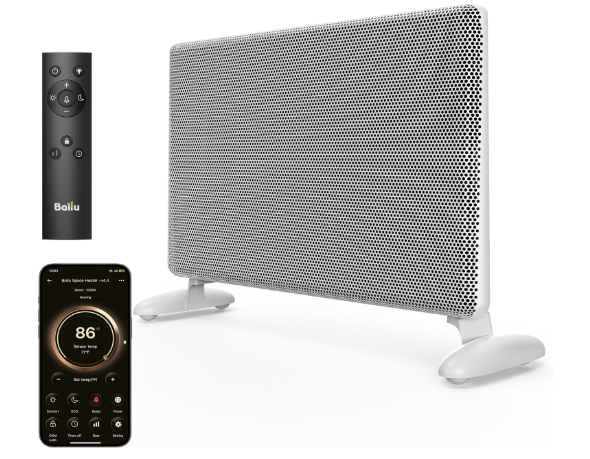
Ballu Mica Infrared Heater
- Covers 250 sq ft
- Programmable thermostat with app
- Stand or wall mount
For Simple Knob Control
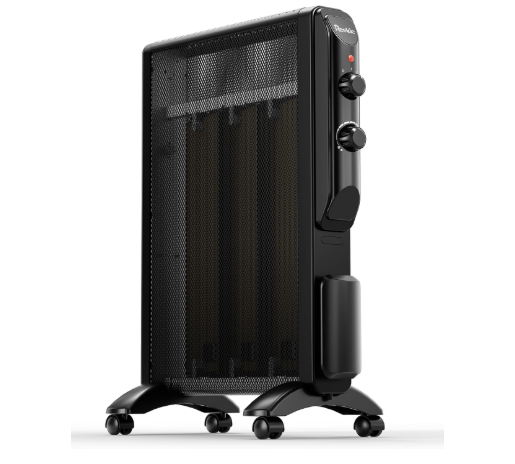
Reekie Portable Mica Heater
- 1000W and 1500W settings
- Covers 180 sq ft
- Four swivel caster wheels
What Is a Micathermic Heater and How It Works
A micathermic heater is an electric heater whose heating element is wrapped in thin sheets of mica, a natural mineral that handles heat well and spreads it evenly. You will also see it called a mica heater, a mica thermic panel heater, or simply a mica panel heater. The names all point to the same basic design.
When the element warms up, the panel heats the room in two ways at once. Part of the warmth is radiant heat, which warms people and furniture in front of the panel much like sunlight. The rest is convection heat, as air touching the hot panel rises and slowly circulates around the room.
That mix explains why a micathermic panel heater feels different from a fan heater. There is no blast of air, so the room warms more gently and with little or no noise. It also explains why many mica units are slim and light, since the thin element does not need the heavy oil reservoir of a radiator.
Why a Mica Heater Makes a Smart Heating Solution
A mica heater solution works best when you treat it as a room heater, not a whole-house system. It suits the spaces you use for hours at a time, like a bedroom, a home office, or a den, where steady and quiet warmth matters more than a fast blast of air.
The biggest draw is calm comfort. A fanless or low-airflow panel does not stir up dust the way a blower can, and it warms both the air and the surfaces around you. Picture reading in bed or working at a desk while the heater runs without a hum.
Mica heating solutions also make sense for budgets and floor plans. If you lower the central thermostat and heat only the room you are in, you avoid warming empty rooms. A wall-mount or slim panel design keeps that warmth tucked out of the way in apartments where every square foot counts.
How These Mica Heater Picks Were Selected
Every heater in this list had to be a true mica heater, with mica named on its product page. Convection-only panels and quartz infrared units were left out, even when they looked similar, because they heat in a different way.
From there, each pick needed 1500-watt class output for standard household outlets, a thermostat, and listed tip-over and overheat protection. Placement options mattered too, so you will find wall-mountable panels alongside freestanding units on casters.
Finally, the list balances control styles. Some readers want app scheduling and voice control, while others want two knobs and nothing else, so both approaches are represented.
Reviews of the Best Mica Heaters
1. Ballu Mica Infrared Heater for Large Room Comfort
The Ballu wraps premium mica panels in an all-metal body and pairs far-infrared warmth with convection. As a mica panel space heater, it is built for larger rooms, with listed coverage of 250 sq ft, a 10-second heat-up, and a 180 degree spread.
You can use the remote, the digital panel, or the app for schedules, and voice control works with a separate Alexa device. A programmable thermostat and a 24-hour timer help it follow your daily routine.
In-Use Impressions: This suits someone who wants the room warm before they walk in, without touching a button. The stand or wall mount choice lets it fit a living room or a tight apartment.
Feature Spotlight
- Programmable thermostat with app scheduling and a 24-hour timer
- 10-second heat-up with 180 degree coverage
Main Advantages
- Gentle far-infrared warmth from mica panels
- Remote, panel, and app control options
- Tip-over shutoff and overheat prevention listed
- Casters or wall mount for flexible placement
Suited To
- Large rooms up to 250 sq ft
- Standard 120-volt household outlets
- Bedrooms, offices, and apartments
- Alexa devices for optional voice control
Before You Choose: At 11.28 pounds, it is heavier than the knob-style picks. ETL certification is a listing claim, so check the label on the unit you receive.
2. Reekie Portable Mica Heater With Two Power Levels
Simplicity is the point of this Reekie. Two knobs handle everything, one for the thermostat and one for power, letting you switch between 1000 and 1500 watts. There is no app to set up and no Wi-Fi to troubleshoot.
The listing describes far-infrared and convection heat that you can feel in less than 30 seconds, with three-dimensional heating for wider coverage up to 180 sq ft. It runs silently and gives off no glaring light, which helps in a bedroom.
In-Use Impressions: Four swivel casters and a cool-touch handle make it easy to roll from the office to the bedroom. The cord winder keeps storage tidy once spring arrives.
Feature Spotlight
- Separate thermostat and power level knobs
- 1000W and 1500W settings for milder or colder days
Main Advantages
- No app or Wi-Fi needed
- Silent operation without glaring light
- Overheat and tip-over protection listed
- Lighter at 7.94 pounds
Suited To
- Bedrooms and offices up to 180 sq ft
- Hard floors where casters roll easily
- Standard 120-volt household outlets
Before You Choose: The listing notes slight white smoke during first use or after long storage is normal. There is no timer or remote, so you switch it off by hand.
3. Ballu Mica Heater Pro With Inverter Smart Heating
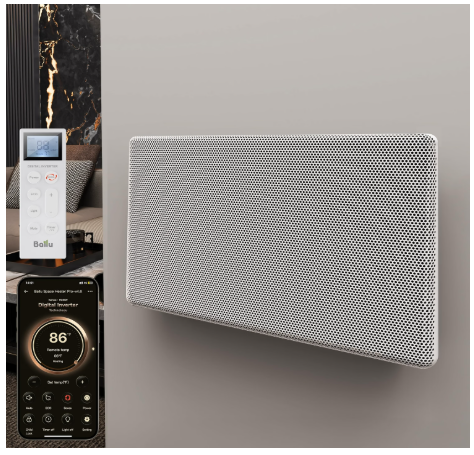
This Pro version keeps the all-metal body, mica panels, 10-second heat-up, and 180 degree spread of the standard Ballu. What changes is the brain behind it.
The listing describes inverter technology and smart algorithms that track your past usage and room temperature changes, then adjust heating to match. A remote with an LED display shows your set temperature, and the app handles schedules, modes, and power levels, with Alexa support.
In-Use Impressions: It fits a household that wants the heater to learn its rhythm rather than follow fixed settings. The wall mount option helps in rooms where floor space is limited.
Feature Spotlight
- Inverter heating that adapts to past usage
- LED display remote with set temperature readout
- App schedules, modes, and power level view
Main Advantages
- Adapts output to room temperature changes
- Clear remote display for quick checks
- Listed coverage of 250 sq ft
- Wall mount saves floor space
Suited To
- Large living rooms and open spaces
- Smartphones for app scheduling
- Alexa devices for voice commands
Before You Choose: Its product page did not clearly confirm wattage or a safety lab listing, so check both on the label and in the manual before setup.
4. Reekie Convection Mica Infrared Heater for Quiet Rooms
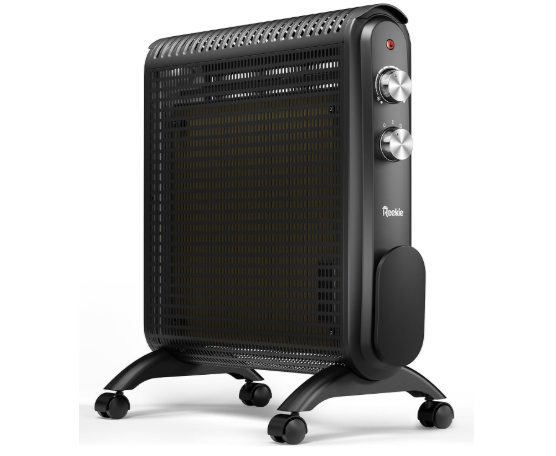
Quiet is where this Reekie earns its place. The listing rates it at 23dB with a fan-free design, so it keeps a bedroom or study calm while it warms.
It combines convection with mica infrared heat and lists warmth within 29 seconds, along with 360 degree three-dimensional heating. Two knobs set the thermostat and switch between 750 and 1500 watts, and the housing uses V0 flame-retardant material.
In-Use Impressions: Light sleepers and anyone on video calls will appreciate the low noise. The 750-watt step gives a softer option for mild evenings or smaller rooms.
Feature Spotlight
- 23dB fan-free operation
- 750W and 1500W power settings
Main Advantages
- Very quiet for bedrooms and offices
- Upgraded safety plug and V0 housing
- 45 degree tip-over and overheat protection
- Simple knobs with no app needed
Suited To
- Bedrooms, studies, and home offices
- Garages kept clear of fuel and dust
- Standard 120-volt household outlets
Before You Choose: The 96.53% efficiency figure is a listing claim, and most electric heaters convert nearly all power into heat. No coverage area or lab listing was stated.
5. Pasapair Mica Panel Heater With Wall or Floor Setup
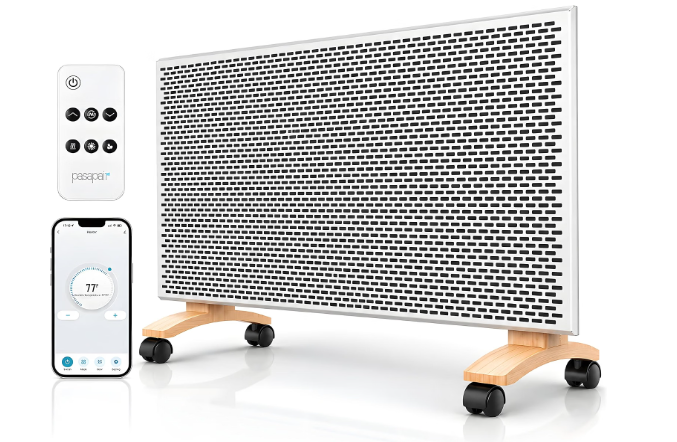
The Pasapair places mica heating elements behind a perforated metal front, so warmth spreads evenly without harsh blowing air. Three power levels, 600, 900, and 1500 watts, cover everything from background warmth to a cold morning boost.
Its thermostat spans 41 to 97 degrees Fahrenheit, with Comfort, ECO, Anti-Frost, and Open Window Detection modes. The Smart Life app sets weekly schedules, and the listing suggests rooms up to 250 sq ft.
In-Use Impressions: Mounted on a wall, it keeps the floor clear around a desk or bed. Swap to the included swivel casters when one heater needs to serve two rooms.
Feature Spotlight
- Open Window Detection with Anti-Frost mode
- Three power levels from 600 to 1500 watts
- Weekly scheduling through the Smart Life app
Main Advantages
- Wide thermostat range for frost protection
- Wall mount or 360 degree swivel casters
- Gentle airflow without a blowing fan
- Light enough to move between rooms
Suited To
- Rooms up to 250 sq ft
- 2.4 GHz Wi-Fi networks only
- Small offices and bedrooms
Before You Choose: App control does not work on 5 GHz Wi-Fi, and the remote needs two AAA batteries you supply yourself.
Choosing the Right Mica Heater for Large Rooms
Large rooms test a heater harder than small ones, so a few details matter more than the brand name on the panel.
Start With Wattage and Listed Coverage
Every pick here reaches the 1500-watt class, the usual ceiling for a portable heater on a household outlet. What differs is the coverage each listing describes. The two Ballu units and the Pasapair list 250 sq ft, while the Reekie HV1201 lists 180 sq ft. Treat those numbers as manufacturer figures, since ceiling height, insulation, and open doorways change real results.
Look at How Heat Spreads
A wide spread helps in an open living area. The Ballu models list a 180 degree spread, which suits a heater placed against one wall and facing the seating area. The Reekie HV1901 lists 360 degree heating, which suits a spot nearer the middle of the room.
Match Controls to Your Routine
Going by the listed specifications, the two Reekie models rely on simple knobs, while both Ballu units and the Pasapair lean on app scheduling. If you leave for work at the same time every day, scheduling saves effort. If you dislike apps, knobs will feel easier from day one. For a wider look at radiant options beyond mica, see these infrared space heater options.
Comparing Controls and Placement Across These Five Heaters
Product pages blur together after a few minutes, so a quick grid helps. This table sticks to details stated in the listings and focuses on how you run each model and where it can sit.
| Model | Control Options | Placement |
|---|---|---|
| Ballu Mica Infrared Heater | Remote, panel, app, Alexa | Stand with casters or wall mount |
| Reekie Portable Mica Heater | Thermostat and power knobs | Four swivel casters |
| Ballu Mica Heater Pro | LED remote, app, Alexa | Freestanding or wall mount |
| Reekie Convection Mica Infrared Heater | Thermostat and power knobs | Freestanding |
| Pasapair Mica Panel Heater | App, remote, touch panel, Alexa | Wall mount or swivel casters |
The pattern is easy to read. The Reekie models keep things manual, the Ballu Pro adds adaptive heating, and the Ballu and Pasapair lean on schedules. Decide which of those matters most, then use the grid to narrow your shortlist.
Wattage and Room Size Quick Reference for Mica Heaters
Matching power to room size prevents two common letdowns, a heater that never catches up and one that cycles on and off constantly. The figures below come from the listings, so read them as starting points.
| Model | Power Settings | Listed Room Fit |
|---|---|---|
| Ballu Mica Infrared Heater | 1500 W, thermostat controlled | Up to 250 sq ft |
| Reekie Portable Mica Heater | 1000 and 1500 W | Up to 180 sq ft |
| Ballu Mica Heater Pro | Inverter controlled | Up to 250 sq ft |
| Reekie Convection Mica Infrared Heater | 750 and 1500 W | Not stated |
| Pasapair Mica Panel Heater | 600, 900, and 1500 W | Up to 250 sq ft |
Use a simple rule when reading the grid. If your room sits near the top of a listed coverage figure, expect a longer warm-up, especially with high ceilings or a drafty window. Closing the door helps the heater focus on one space, and lower steps like 600 or 750 watts suit small rooms or milder days.
Matching a Mica Space Heater to Each Room Type
Different rooms ask different things from a heater, so these scenarios match features to real situations.
Bedroom Before Sleep
You want quiet, not a roaring fan. The fan-free Reekie HV1901 lists 23dB, and both Reekie models skip glaring lights. Warm the room before bed, then switch the heater off before you fall asleep. If you are unsure which types suit longer sessions, this guide on heaters safe to leave on overnight explains the risks.
Home Office Under 250 Square Feet
A wall-mounted Pasapair keeps the floor clear around your desk. Its app scheduling can warm the room before you sit down, and ECO mode trims output once you reach your target temperature.
Garage or Workshop
The standard Ballu listing names garages, and caster-equipped models roll easily to a workbench. Garages bring extra risk, so keep fuel, paint, solvents, and sawdust well away. Cold concrete and gaps under the door also slow warm-up, so give the heater a head start.
Smart Controls and Thermostat Settings Worth Using Daily
A thermostat separates a heater you babysit from one you trust. The Pasapair spans 41 to 97 degrees Fahrenheit, and that low end matters if you want frost protection in a cool spare room without heating it fully.
Smart features add convenience. The Pasapair offers Comfort, ECO, Anti-Frost, and Open Window Detection, so a sudden temperature drop from an open window triggers a lower-output mode. The Ballu Pro takes a different route, learning from past usage and adjusting its output on its own.
Think of a real morning where the heater warms the room twenty minutes before your alarm and you never touch a button. That is the case for scheduling. If you prefer no apps at all, the knob-based Reekie models still give you a thermostat that cycles the heat for you.
Remember the setup limits. The Pasapair needs a 2.4 GHz network, and voice control on any of these needs a separate Alexa device.
Safety Features to Check on Any Mica Heater
Safety features are not optional extras on a space heater. Use this checklist while you compare listings, and again when you set the heater up at home.
- Independent lab listing. The Ballu lists ETL certification and the Reekie HV1201 lists UL. Look for a similar mark on the unit itself.
- Tip-over shutoff. Every pick here lists tip-over protection, which cuts power if the heater falls.
- Overheat protection. Each listing describes a cutoff that shuts the heater down if internal parts run too hot.
- Flame-retardant materials. The Reekie HV1901 lists V0 housing, and the standard Ballu lists a flame-retardant cord.
- Clearance. Keep anything that can burn at least three feet away, including curtains, bedding, and furniture.
- Direct outlet use. Plug straight into a wall outlet rather than an extension cord or power strip.
- Supervision. Turn the heater off when you leave the room or go to bed.
A feature list never replaces good habits. Even a well-built panel becomes risky when it sits too close to a blanket, so treat placement as part of the safety system. Families can also read whether a heater in a child’s room is a sensible idea.
Wall Mount or Freestanding Placement Tips for Panel Heaters
Placement affects both comfort and safety, so a few quick checks pay off.
- Choose wall mounting for small rooms. The Ballu models and the Pasapair support wall installation, which frees floor space and keeps the heater out of foot traffic.
- Follow the mount instructions closely. Use the supplied kit with anchors suited to your wall type, and confirm the bracket is level.
- Use casters for flexibility. Wheels help when one heater serves a bedroom at night and an office by day.
- Set freestanding units on a flat, hard surface. A tilted floor or thick rug can make tipping more likely and can trap heat.
- Keep the cord visible and slack. Never run it under a rug or across a walkway.
- Stay away from water. Bathrooms and damp basements need extra caution, so follow the manual for any wet-area limits.
- Leave breathing room around the panel. Furniture pushed against the front blocks heat and raises risk.
Mica Heater Versus Ceramic and Oil-Filled Heaters
Choosing between heater types is easier when you see how each one makes and moves warmth. The comparison below keeps to general descriptions.
| Heater Type | How It Heats | Typical Fit |
|---|---|---|
| Mica panel | Mica element with convection and gentle radiant warmth | Quiet bedrooms and offices |
| Ceramic | Air warmed over a ceramic element, often with a fan | Fast spot warming |
| Oil-filled | Heated oil circulates through a radiator body | Slow, steady room warmth |
Mica models usually sit between the other two. They respond faster than a heavy oil-filled radiator because the thin panel warms quickly, and they tend to run quieter than fan-based ceramic units. Oil-filled heaters keep radiating after you switch them off, which some people like for long evenings, while a ceramic heater suits a quick burst under a desk. For a closer look at those two, see this breakdown of ceramic and oil heaters.
Common Micathermic Heater Styles and Where Each Fits
Micathermic heaters come in a few familiar shapes, and the style often matters as much as the wattage.
Flat Panel Heaters
A flat micathermic panel heater looks like a slim board on feet or casters. It spreads warmth across a wide face, which suits a living room or bedroom wall. The Ballu units and the Pasapair follow this layout.
Wall-Mounted Panels
Many panels convert to wall mounting. This style frees the floor completely and keeps the heater away from toys and foot traffic, which helps in small offices, apartments, and kids’ rooms.
Freestanding Portable Units
Freestanding micathermic space heaters sit on wheels with a carry handle and simple knobs. The two Reekie models fit this group. They move easily from room to room but always need floor space and clearance around them.
Pick the style first by asking where the heater will live most of the season. A permanent spot points to a wall panel, while a heater that follows you around points to a portable unit.
Running Cost of a 1500 Watt Mica Heater
Running cost comes down to simple math. Divide the wattage by 1000 to get kilowatts, multiply by the hours you run it, then multiply by the rate per kilowatt-hour on your electric bill.
| Power Setting | Energy Used per Hour at Full Output |
|---|---|
| 600 W | 0.6 kWh |
| 750 W | 0.75 kWh |
| 1000 W | 1.0 kWh |
| 1500 W | 1.5 kWh |
So a 1500-watt heater running flat out for eight hours uses 12 kWh. In practice, a thermostat cycles the element on and off once the room is warm, so real use is often lower than that ceiling.
The cheapest heat is the heat you do not need. Lower settings, ECO modes, closed doors, and schedules that skip empty hours all cut the bill more than any heater type does.
Limits Where a Mica Heater Falls Short
A fair guide should say where a mica heater disappoints. Knowing the limits keeps expectations realistic.
It Heats a Room, Not a Home
A single panel cannot replace a furnace. In a poorly insulated room with leaky windows, the heater works hard and the space still feels cool. Fix drafts first, then add the heater.
Efficiency Claims Need Context
Listings mention efficiency figures and energy savings, yet nearly every electric space heater turns almost all the power it draws into heat. Wattage and run time decide your use, not marketing language.
Fanless Warmth Is Slower in Big Spaces
Without a fan, warm air spreads by natural circulation. In a large open room, you may feel heat quickly in front of the panel while far corners take longer to catch up.
Smart Features Depend on Setup
App scheduling needs a working Wi-Fi connection, and voice control needs a separate device. If your network drops, you fall back on the remote or panel.
Frequently Asked Questions About Mica Heaters
Is a Mica Heater Worth Buying Over a Ceramic Heater?
It depends on how you use the room. A mica heater is worth it when you value quiet, even warmth for hours, such as in a bedroom or office, because most mica designs run without a loud fan. A ceramic heater makes more sense for quick spot heating under a desk or in a bathroom-sized space, since its fan pushes warm air fast. Both draw similar power at the same wattage, so comfort and noise should drive the choice.
Why Does a New Mica Heater Smell or Smoke Slightly?
New heating elements often carry a thin coating from manufacturing, and dust settles on any heater kept in storage. The first warm-up burns that off, which can cause a brief smell or light wisp. The Reekie HV1201 listing notes this as normal. Run the heater in a ventilated room for the first session and stay nearby. If smoke continues, grows heavier, or smells like melting plastic, unplug it and contact the maker.
Can a Mica Panel Heater Stay On Overnight?
Fire safety guidance says to turn space heaters off when you go to bed or leave the room, and that includes mica models. A schedule or timer can warm the room before sleep, but you should still switch it off yourself. If you want protection against freezing in an empty room, a frost mode like the Pasapair’s Anti-Frost setting holds a low temperature without full output, though supervision rules still apply.
Is a Mica Heater Safe Around Children and Pets?
Safety features lower risk without removing it. Tip-over protection cuts power if a pet bumps the unit, and wall mounting lifts the heater out of reach entirely. Panel surfaces and metal frames can still get hot, so create a clear zone around the heater and keep cords out of reach. Choosing a wall-mountable panel, like the Ballu models or the Pasapair, is often the easiest fix in a playroom or nursery.
Does a Mica Heater Dry Out the Air?
Any heater that warms air lowers its relative humidity, because warm air holds more moisture than cool air. A fanless mica panel avoids the strong airflow that can make skin and eyes feel dry, so many people find it gentler than a blower. In very dry climates or long heating seasons, a separate humidifier does far more for comfort than the heater type does.
How Do You Clean a Mica Heater?
Unplug the heater and let it cool completely first. Wipe the outer case with a dry or slightly damp soft cloth, and use a soft brush or vacuum attachment on the grille and vents to lift dust. Never spray liquid onto the unit or let moisture reach the controls. Clean before the first cold snap each year, since a dusty panel is the main cause of that burnt smell at startup.
Picking Warmth That Suits Your Room Best
A good mica heater comes down to a few practical calls. Match wattage and listed coverage to your room, pick controls you will truly use, and confirm tip-over and overheat protection before anything else. Knob-style Reekie models suit people who want simplicity, while the Ballu models and the Pasapair suit scheduled routines and wall mounting.
Keep the limits in view. A mica panel warms a room, not a house, and it works best with the door closed and the central thermostat turned down.
A useful rule is to start with your room size, then your control style, then placement. If you want one heater that covers a large room with flexible control, the Ballu Mica Infrared Heater is the calm, sensible place to begin.
