
Best Wood Stove Humidifiers for Dry Winter Rooms (Updated)

Disclosure: As an Amazon Associate, I earn from qualifying purchases. Learn more
Firelight warms the bones, yet it quietly drinks the moisture from every breath you take. For most homes, the Fire Beauty Wolf Stove Humidifier is the simplest place to start, a solid cast iron pot with a carved lattice lid that turns stove heat into gentle room moisture without power or filters.
Fast Humidifier Verdict
Our pick is the Fire Beauty Wolf Stove Humidifier, a cast iron pot with a carved lattice lid that suits wood and gas stove tops → View on Amazon
Consider the Minuteman Moiety Insert Humidifier if your insert has only a narrow ledge and a regular pot will not sit flat → View on Amazon
The tricky part is matching the humidifier to your setup. You need a pot that fits the flat space on your stove or insert, holds enough water for a full burn, and gives you a realistic boost in humidity rather than a promise it cannot keep. A small humidity gauge turns all of this from guesswork into a number.
Below you will find four cast iron options for different stoves, plus clear guidance on how much moisture to expect, where it travels, and when to stop.
For scent and decor, the Fire Beauty Wolf Stove Humidifier brings a carved lattice lid, while the GOOD GAIN Lattice Stove Humidifier adds a wide fill opening and enamel coating.
For Scent Diffusion

Fire Beauty Wolf Stove Humidifier
- Carved wolf lattice lid
- No power or filters
- Dual side handles
For Easy Pouring

GOOD GAIN Lattice Stove Humidifier
- Porcelain enamel coating
- 3.54-inch fill opening
- 2.5-quart capacity
Why a Cast Iron Stove Humidifier Needs No Power
A stove humidifier is simply a heavy vessel of water resting on a hot surface. The stove heats the iron, the iron heats the water, and the water slowly turns to vapor that rises into the room.
No motor, cord, wick, or filter is involved. That makes it quiet, cheap to run, and useful during a winter power outage, as long as the fire keeps burning.
Cast iron is the usual material because it holds heat evenly and stays put when someone brushes past the stove. A protective interior, such as porcelain enamel or a rust-resistant finish, keeps the water from attacking the metal.
One thing a stove humidifier does not do is make your stove burn more efficiently or push heat further. Treat it purely as a moisture helper.
How Much Moisture a Stove Top Humidifier Adds
Less than many people expect. A pot can only add the water it evaporates, and that depends on surface temperature, the open area of the lid, and how many hours the stove runs.
Going by the listed specifications, the four picks in this guide hold between 2 and 3 quarts, which sets a hard ceiling on how much water each one can release per fill.
A pot on an idling stove steams slowly. A hot stovetop and a lattice or open lid release vapor faster. How much that changes your reading depends on room size, ceiling height, and how much dry outdoor air leaks in around doors and windows.
If one pot barely moves your gauge in a large space, a second pot or a plug-in unit in a far room often helps more than a bigger pot on the same stove.
Comfort Gains and Honest Limits of Stove Humidifiers
Warming cold winter air lowers its relative humidity, which is why a stove-heated room can feel parched by midwinter.
Adding some moisture back can help in everyday ways:
- Skin, lips, and nasal passages that feel less dry
- Fewer static shocks from carpets and blankets
- Wood floors, furniture, and instruments that are less likely to shrink or split
- A gentle scent if you add natural aromatics
A stove humidifier is a comfort aid, not a medical device. If coughing, irritation, or dryness keeps bothering you, a doctor is the right person to ask. Measuring humidity also keeps you from overshooting into damp territory.
Four Stove Humidifiers Matched to Different Setups
1. Fire Beauty Wolf Stove Humidifier With Carved Lattice Lid
Scent lovers get the most from this pot. Its hollow carved lattice lid widens the evaporation area and has room for potpourri, so the stove doubles as a natural diffuser.
The thick solid cast iron body uses an anti-rust black paint and an integrated casting with no loose assembly parts. The smooth inner wall rinses quickly, and the maker suggests occasional seasoning to keep the iron looking fresh.
In-Use Impressions: As a cast iron wood stove humidifier with a decorative top, it reads as part of the hearth rather than an add-on, and the removable lid makes refills simple.
Key Highlights:
- Lattice lid that holds aromatics
- One-piece casting with no loose parts
Practical Gains:
- Runs on stove heat alone
- Quick rinse after each use
- Side handles for repositioning with mitts
Suited To:
- Wood burning stoves and gas stoves
- Household heating stoves with a flat top
Fair Warning: The interior relies on a painted, seasoned finish rather than enamel, so dry it fully after use. The handles heat up with the pot.
2. Larger Capacity Fire Beauty Humidifying Iron Kettle for Stoves

For long heating days, capacity is what counts, and this kettle holds a full three quarts. That means fewer trips with the water pitcher on days the stove never goes out.
Heavy solid cast iron is built for long hours on wood stoves, pellet stoves, indoor fireplaces, and most flat stovetops. A reinforced spring chrome handle is described as cool-touch for lifting, and a wide flat base helps it sit without sliding.
In-Use Impressions: The classic kettle silhouette suits farmhouse and cabin rooms, and the deeper reservoir keeps steam going through long burns.
Key Highlights:
- Three-quart interior for long cycles
- Cool-touch spring handle design
Practical Gains:
- Fewer refills during all-day heating
- Stable base resists tipping
- Easy to carry to the sink
Suited To:
- Wood and pellet stoves
- Indoor fireplaces with flat stovetops
Fair Warning: A cool-touch handle does not make the kettle body cool. Wear mitts and never let it run dry.
3. GOOD GAIN Lattice Stove Humidifier With Wide Fill Opening
Refilling without lifting is the main draw. A 3.54-inch opening in the center of the lattice lets you pour water straight in while the pot stays on the stove.
The body is cast iron with a porcelain enamel coating and weighs 10.56 pounds. It holds 2.8 liters (2.5 quarts), and the traditional lattice top lets water vaporize freely while giving the stove a classic look.
In-Use Impressions: It fits people who check and top up water often, and the enamel interior makes rinsing easy between uses.
Key Highlights:
- Pour-through center opening
- Enamel-coated cast iron
Practical Gains:
- Refills without moving the pot
- Interior resists rust
- Heavy body stays steady
Suited To:
- Flat-top wood burning stoves
- Potpourri on the lattice for light scent
Fair Warning: Over 10 pounds empty, it is heavy once filled. Move it slowly with mitts and only after it cools.
4. Minuteman Moiety Insert Humidifier for Narrow Stove Ledges
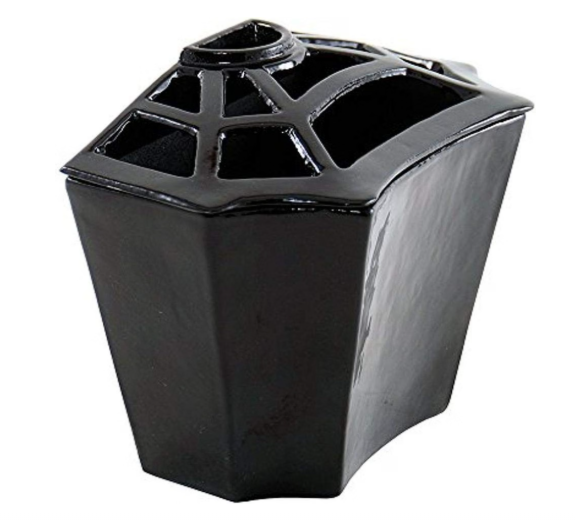
Most stove humidifiers assume a wide, flat stovetop. This one is specially designed for the narrow ledges and mantle shelves of wood stove inserts, where a standard round or oval pot will not sit safely.
It is cast iron with a black enameled interior and exterior, a removable top for filling and cleaning, and a 2-quart capacity. At about 6 pounds, it is the lightest pick in this guide.
In-Use Impressions: It solves a fit problem that larger pots cannot, so insert owners finally get a stove-heated moisture option.
Key Highlights:
- Slim shape for insert ledges
- Enamel finish on both sides
Practical Gains:
- Fits where wide pots overhang
- Exterior enamel wipes clean
- Lighter to lift once cool
Suited To:
- Wood stove inserts with a top ledge
- Narrow mantle shelves that get warm
Fair Warning: With 2 quarts and a ledge that may run cooler, steam output is modest. Measure your ledge depth before ordering.
Lid Styles That Change How Fast Vapor Escapes
The lid is the throttle on any stove humidifier. Two pots on the same stove can release very different amounts of vapor because of what sits on top.
- Lattice or carved lid: many openings spread vapor out and can hold potpourri
- Center fill opening: lets you pour without lifting the lid, with steady venting
- Kettle with a small lid: releases vapor more slowly but holds heat and water longer
- Solid removable top: slows output the most, which suits cooler insert ledges
If your gauge climbs too high, a more closed lid or a cooler spot on the stove gives you an easy way to dial it back.
Wood Stove Insert Humidifier Options for Narrow Ledges
Inserts are the hardest setup to humidify from the stove. Many have only a shallow ledge above the door, and that ledge is often recessed into the fireplace opening.
Before you buy, measure the usable depth and width of the ledge, then compare it with the pot’s listed dimensions. Any overhang can make the pot tip or heat unevenly.
A slim pot made for inserts, like the Minuteman Moiety Insert Humidifier, is the stove-based route. If your insert has no flat surface at all, a plug-in humidifier placed away from the heat is the safer way to add moisture.
Choosing a Wood Stove Humidifier for Your Stove Top
Check these points before you pick a pot, starting with a tape measure.
| What to check | Why it matters |
|---|---|
| Flat footprint | The pot must sit fully flat with space around it |
| Interior finish | Enamel resists rust; painted iron needs drying and seasoning |
| Capacity | 2 to 3 quarts sets how often you refill |
| Fill access | An opening lets you top up without lifting |
| Handles | Side or spring handles make moving it easier once cool |
| Lid style | Open lids release vapor faster than closed ones |
If you would rather compare broader, shallow cast iron steamer pots with decorative lids, that guide covers more pot shapes and finishes.
Measuring Room Humidity Before and After You Steam
A small digital hygrometer is the best companion for any stove humidifier. It shows whether your pot is helping, falling short, or overshooting.
- Place the gauge at sitting height, a few feet away from the stove so it reads the room rather than the heat.
- Note the reading with the stove running and no pot for a day.
- Add the humidifier and check again after several hours of steady burning.
- Adjust with a second pot, a different lid, or a cooler stove position.
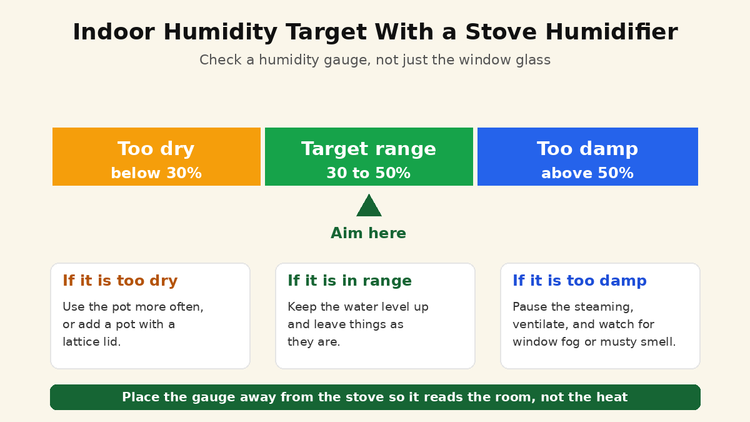
For a target, EPA moisture guidance recommends keeping indoor humidity below 60 percent, ideally between 30 and 50 percent.
Room Size and Airflow Decide How Far Moisture Travels
A stove humidifier adds moisture where the vapor rises, which is right above the stove. How far it spreads depends on how air moves through your home.
Open floor plans share moisture more easily than closed rooms. Doorways, stairwells, and ceiling fans on a low setting help carry warm, moist air outward, and these tips on how to move warm air between rooms apply to humidity too.
Drafty houses lose moisture quickly as dry outdoor air leaks in. In that case, sealing obvious gaps may raise your reading more than adding another pot.
Using a Stove Top Humidifier Step by Step
- Check your stove manual to confirm items are allowed on the top surface.
- Set the pot on a clean, dry, flat spot away from the flue pipe.
- Fill with water, leaving space at the top so it does not boil over.
- Light the stove and let the pot warm with it, rather than adding a cold pot to a very hot top.
- Check the water level often and refill before it runs low, pouring slowly with mitts on.
- Add cinnamon sticks, mint leaves, or potpourri if you like a light scent.
- At season’s end, empty, dry, and store the pot in a dry place.
Cleaning and Caring for Your Cast Iron Humidifier
Cleaning takes minutes when the pot is cool and empty.
- Cool first: washing a hot pot can damage the finish through sudden temperature change
- Rinse and wipe: a damp cloth or soft brush handles smooth interiors
- Skip harsh tools: sharp objects and strong cleaners can wear the coating
- Dry completely: leftover water invites rust, especially on painted iron
- Season only bare or painted iron: enamel-lined pots do not need oil
- Inspect regularly: retire a pot with cracks or chips inside
Distilled water reduces white mineral scale if you live in a hard water area.
Signs Your Room Is Too Damp From a Stove Humidifier
More moisture is not always better. EPA material on mold notes that humidifiers can raise indoor humidity enough to support mold when levels stay high.
- Window condensation: warm, moist air meeting cold glass
- Musty smell: a hint that dampness is building somewhere
- Visible mildew: check window frames, corners, and walls behind furniture
- Gauge readings above 50 percent that stay there for days
If you see these signs, pause the steaming, ventilate, and recheck the gauge. If dampness persists, a dehumidifier may help, and this guide to placing a dehumidifier covers where it can go.
Stove Top Humidifier or Electric Unit for Bedrooms
Both add moisture, but they work best in different parts of the house.
- Stove top humidifier: no power or filters, runs while the stove is hot, modest output in one room
- Electric humidifier: works with the stove off and in any room, but needs power and regular cleaning
- Bedrooms far from the stove: an electric unit usually reaches them better
- Quick rule: use the stove pot for the main room, and add a plug-in unit if distant rooms stay dry
If you add an electric unit, it is worth reading up on plug-in humidifier safety before placing it.
Mistakes That Cut Humidity Output or Damage Pots
- Parking the pot on the coolest corner: it stays safe but barely steams
- Letting it boil dry: an empty pot overheats, which can mark the stove and harm the finish
- Adding cold water to a dry, hot pot: the shock can crack enamel or iron
- Reusing old water for days: dust and minerals build up; start fresh each day
- Measuring next to the stove: the gauge reads heat, not the room
Still Have Questions About Stove Top Humidifiers
Can you put essential oils in a wood stove humidifier?
Some listings say you can place potpourri or essential oils in a lattice lid, while others suggest cinnamon sticks or mint leaves in the water. Keep it light, since strong scents can bother children, pets, and anyone with sensitivities. Never let oils or potpourri sit directly on the hot stove surface, and stop if you notice smoke or a burning smell. Check your pot’s instructions and stove manual before adding anything beyond plain water.
Is the water in a stove humidifier safe to reuse?
It is better not to. Water that sits on a warm stove for days collects dust, minerals, and leftover aromatics, so empty and rinse the pot rather than topping it up forever. Start each day with fresh water, and never drink or cook with water from the pot. In hard water areas, distilled water cuts down the white scale that builds up inside the pot over a season.
Can you use a stove humidifier on a pellet or gas stove?
Often yes, when the listing and your stove manual allow it. Several of these pots mention gas stoves, pellet stoves, or indoor fireplaces. Gas and pellet stoves can run cooler on top, so the water may steam more slowly than on a hot wood stove. Make sure the base sits fully flat on the surface, and never place a pot where it blocks vents, sensors, or controls.
Can a stove humidifier damage your stove top?
It can if it boils dry or spills. An empty pot overheats its base and may mark the stovetop, and boil-overs can leave stains on some finishes, especially natural stone. Lift the pot rather than dragging it, keep its base clean and dry, and ask your stove maker about soapstone or enameled tops. Heavy cast iron can also scratch painted surfaces, so set it down gently every time.
Why is my stove humidifier barely steaming?
The surface under it is probably not hot enough. Low burns, a recessed insert ledge, or a spot far from the firebox all slow evaporation. Try moving the pot closer to the hottest flat area your manual allows, or swap to a pot with a more open lid. Remember that gentle steaming is normal; you do not need a rolling boil for the water to evaporate into the room.
How many stove humidifiers does an open floor plan need?
Start with one and watch your gauge for a few days. Open layouts spread moisture farther but also dilute it, so a single pot may only nudge the reading. If the main area stays below about 30 percent with the stove running, a second pot on the stove or a plug-in unit in a distant room usually helps. Stop adding moisture once readings sit comfortably in the 30 to 50 percent range.
Picking a Humidifier That Suits Your Stove
A stove top humidifier is a quiet, power-free way to soften dry winter air, provided it fits your stove and you expect a gentle boost rather than whole-house humidity. It needs regular refills and a watchful eye so it never runs dry.
Use this rule: measure your flat space first, choose capacity by how long you burn, and let a hygrometer tell you when to add more or stop. If you want one reliable choice for most stove tops, the Fire Beauty Wolf Stove Humidifier is a sensible place to begin.
